Allan Rohan Crite’s oil painting Front of Saint Paul’s Cathedral, Tremont Street (1936) depicts a bustling moment on the sidewalk, with people making their way around downtown Boston. It is a multiracial scene; each person is well dressed, seemingly on their way to somewhere important. No face looks desultory or downtrodden, despite it being in the midst of the Great Depression. Crite captures the block’s layers of architecture with exquisite care, offering two small triangles of blue sky above the Episcopal cathedral that accentuate the way it is sandwiched between two much taller buildings, a somewhat awkward yet charmingly Bostonian architectural look. Painted in 1936, decades before I was born, the painting records a timeless energy of the space—evoking my own memories of passing this very church on my way to Lambert’s Marketplace. My grandfather, my sisters, and I would buy bags of peanuts there and take them across the street to the Boston Common to feed pigeons and squirrels. Routinely, we would drive by the Shaw memorial on the opposite side of the Common on our way home to Cambridge—another Boston landmark Crite would render in Meeting at St. Gaudens Shaw Memorial (1944), using watercolor on paper.
Crite (1910–2007), the famed artist, mentor, and resident of Boston’s South End neighborhood, is the subject of a crosstown retrospective. At the Isabella Stewart Gardner Museum, not far from where Crite lived, the Hostetter and Fenway galleries respectively host “Allan Rohan Crite: Urban Glory” and “Visions of Black Madonnas,” curated by Diana Seave Greenwald in partnership with Theodore Landsmark (both on view October 23, 2025–January 19, 2026), while the Boston Athenaeum simultaneously hosts “Allan Rohan Crite: Griot of Boston,” curated by Christina Michelon (on view October 23, 2025–January 24, 2026). Collectively, these exhibitions—and ample related shows and events that engage his many mentees—evince the intensity of Crite’s prolific practice and the countless ways his spirit and influence carry through Boston and beyond. Spread across each exhibition site are entryways into his oeuvre through scenes that are reportive yet memoiric, divine yet ordinary, local and contemporary, global and ancient, across media ranging from singular watercolor, gouache, and oil painting to sketches and lithographs reproduced by the artist himself in mass quantity.
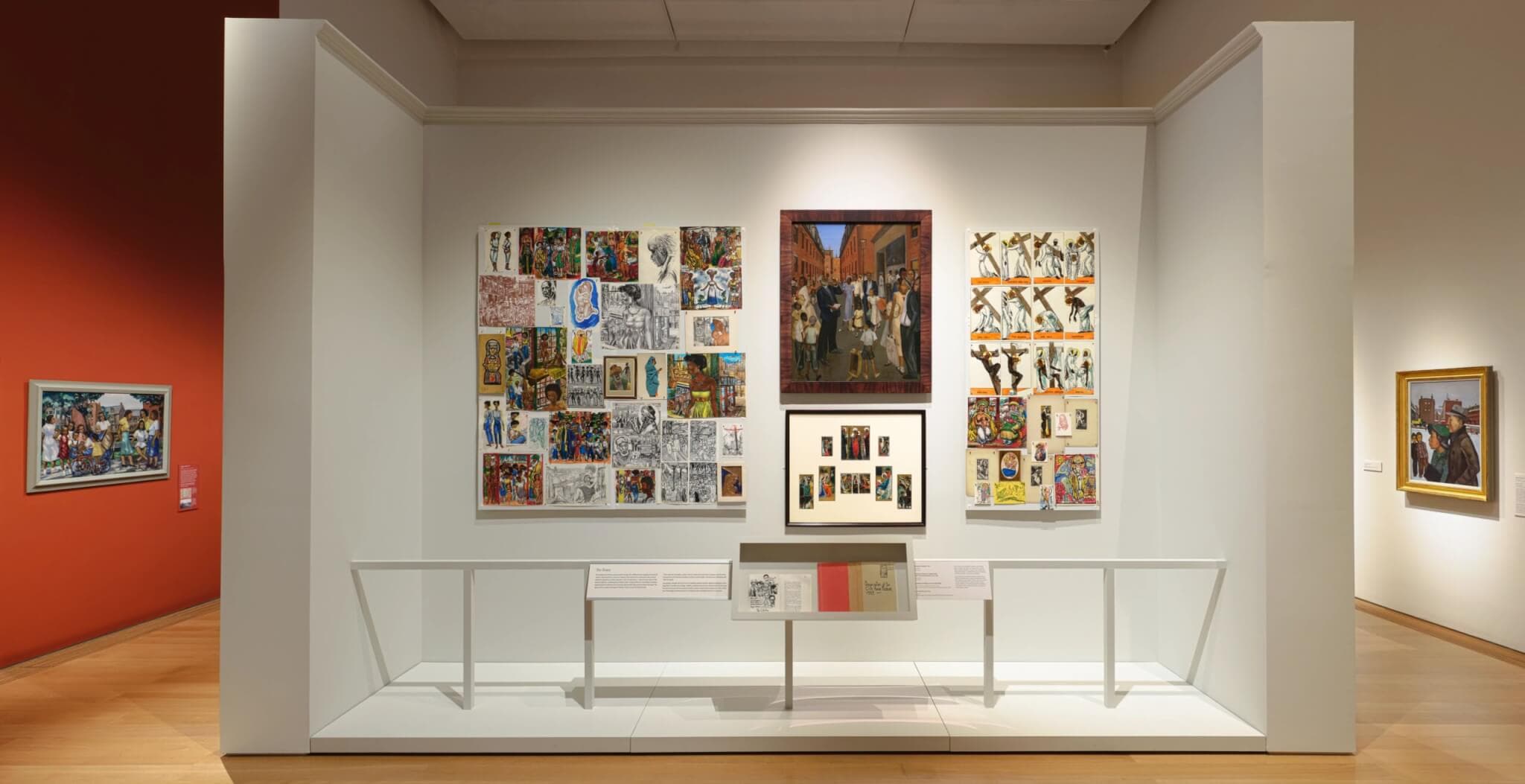
Installation view, “Allan Rohan Crite: Urban Glory,” in Hostetter Gallery, October 23, 2025–January 19, 2026. Courtesy of Isabella Stewart Gardner Museum, Boston.
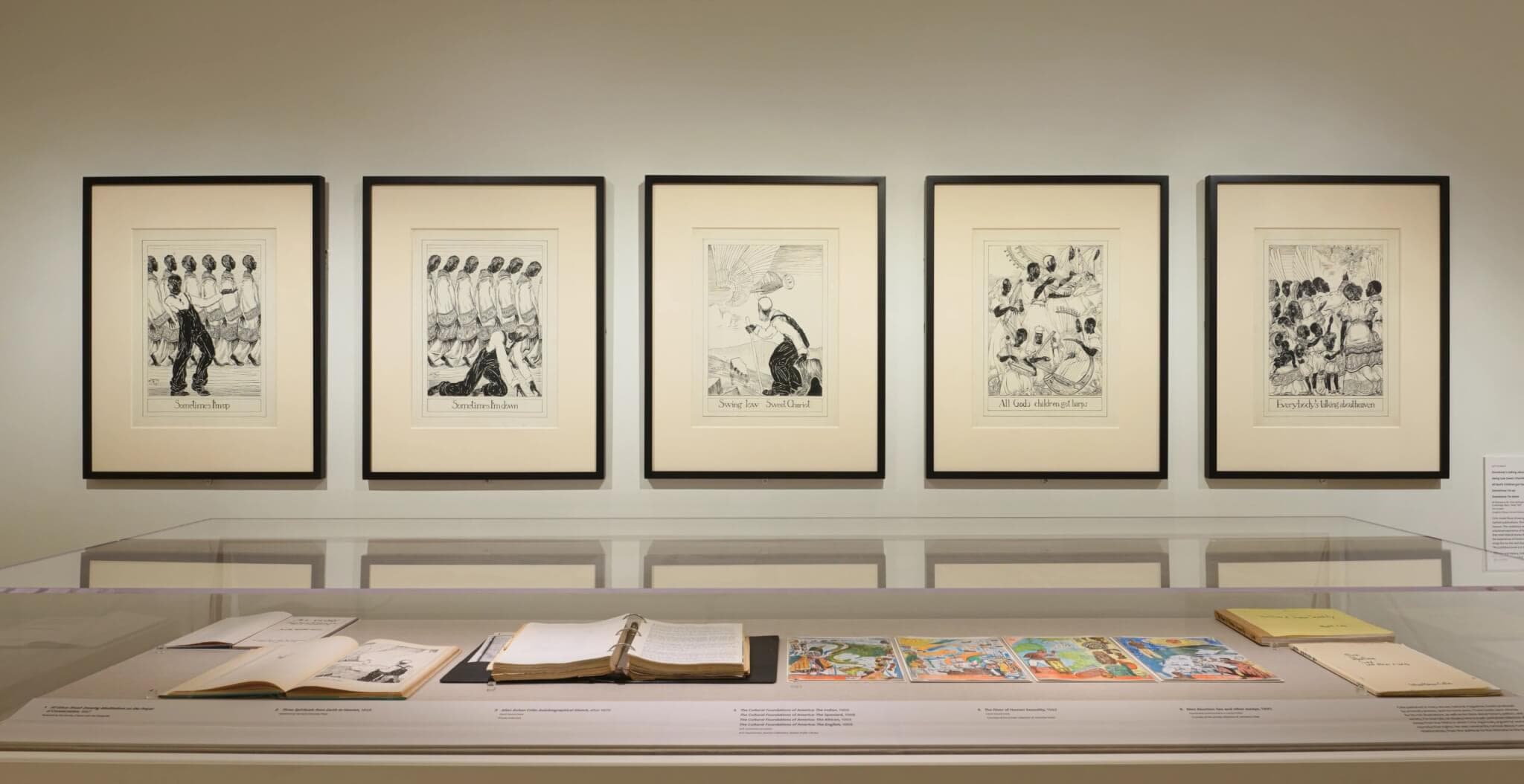
It is felicitous to witness Crite’s work within places he was known to love. Upstairs in the Hostetter Gallery at the Gardner, the show opens with an introduction to Crite’s work that samples its scope—two self-portraits, an oil painting of Lower Roxbury, a watercolor of a crowded train car, explorative drawings of African sculptures, a series of illustrations of Black spirituals titled Three Spirituals from Earth to Heaven (1937), and the iconic Streetcar Madonna (1936)—before turning toward the artist’s legacy and relationships with other artists in his community. The Fenway Gallery focuses exclusively on depictions of Black Madonnas, situating Crite within centuries of history. At the Athenaeum, special attention is paid to the artist’s works on paper to anchor him as a keeper of knowledge of Boston’s history. Throughout his work at each site, Black epistemologies are prominent subjects and methods in Crite’s artistic practice, as seen in his paintings of his community from the first half of the twentieth century and through the lithography that dominates the latter half.
Settling the World’s Problems (1933) at the Athenaeum, for instance, speaks to a form of intergenerational exchange where Black Bostonians may acquire knowledge and develop political thought. Two park benches anchor the scene. At right, four men gathered around one bench look and gesture toward a fifth man on the opposite bench. Crite decisively splits the canvas down the middle and allows an animated neighborhood backdrop to billow behind the figures in the foreground. Contrasting the otherwise leisurely atmosphere, the men’s faces denote a mix of assertiveness, passion, and focus during their worldly debate in Roxbury’s (since repurposed) Madison Park. A cluster of women in the top left quadrant smile amicably at each other, perhaps fawning over the baby in one’s arms. But what piques my interest in this painting is the four children in the bottom left. They are actively observing the adults around them, and notably not playing among themselves, despite the presence of a red kickball and a doll held by one little girl. I wonder: What are they picking up on? What from this day will they internalize? Children are consistently present in Crite’s paintings of Boston neighborhoods, reflecting an era when families strove to maintain themselves in the city. Significantly, Crite’s attention to children foreshadows the way he ultimately became a mentor for Boston’s younger Black art community during his elder years and his production of reparative curricula for fourth and fifth grades.
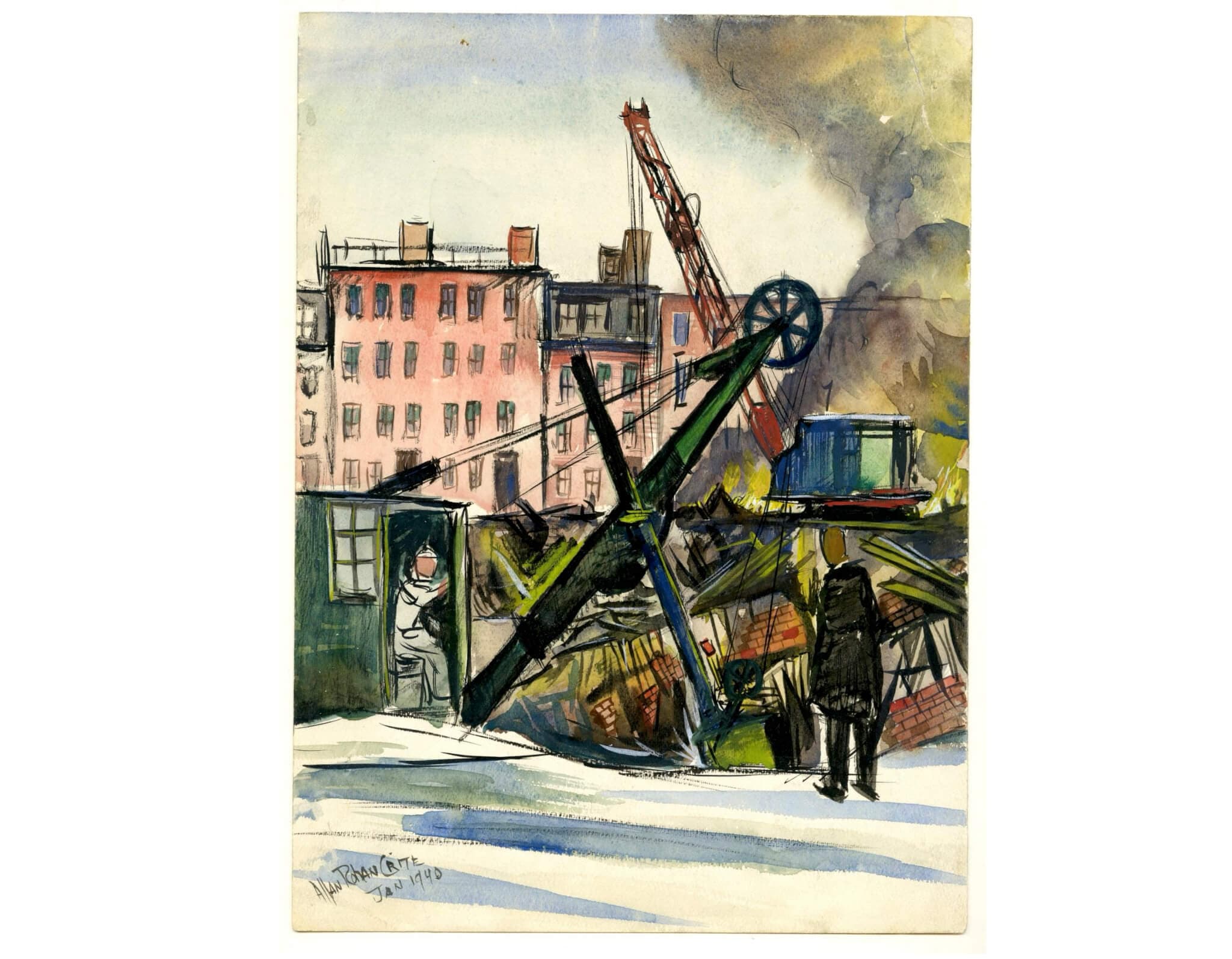
Allan Rohan Crite (American, 1910–2007), Burning and Digging: South End Housing Project, January 1940. Watercolor with ink and white highlights. Boston Athenaeum, Gift of the artist, 1971. Courtesy of the Allan Rohan Crite Research Institute and Library.
Crite’s work brings me the joy of seeing places, like St. Paul’s Cathedral, that I recognize from my lifetime here in the Boston area. But what is even more thrilling is recognizing the stories and places of my ancestors in his work. On view in the Hostetter Gallery at the Gardner, Burning and Digging: South End Housing Project (1940) employs watercolor and ink to produce a muddied color palette that is most saturated in the heart of the destruction it conveys. Slanted bricks fall to the ground as smoke rises in the air. A bulldozer and a crane in the frame at once emphasize the speed of change, and in the background, other buildings loom with fates unknown.
The watercolor conjures stories of my great-grandmother Clorae Evereteze’s fight for housing justice across the river. Her leadership of the Tenant Council at Roosevelt Towers in Cambridge is part of my family lore that I see connected to Crite’s visual art and legacy. In keeping with a national trend toward urban redevelopment, during the 1950s–1970s, the city of Boston embarked on its “urban renewal program,” which Crite sardonically referred to as “urban removal.” As I explore the Crite exhibitions and learn about his stance on “urban removal” in Boston, my great-grandmother’s resolve to sustain her predominantly Black nearby community is at the forefront of my mind. Burning and Digging suggests a loss amidst its change. Still, stories of resistance must be told, regardless of the ultimate outcomes, because they provide us with our history, sense of place, and belonging.
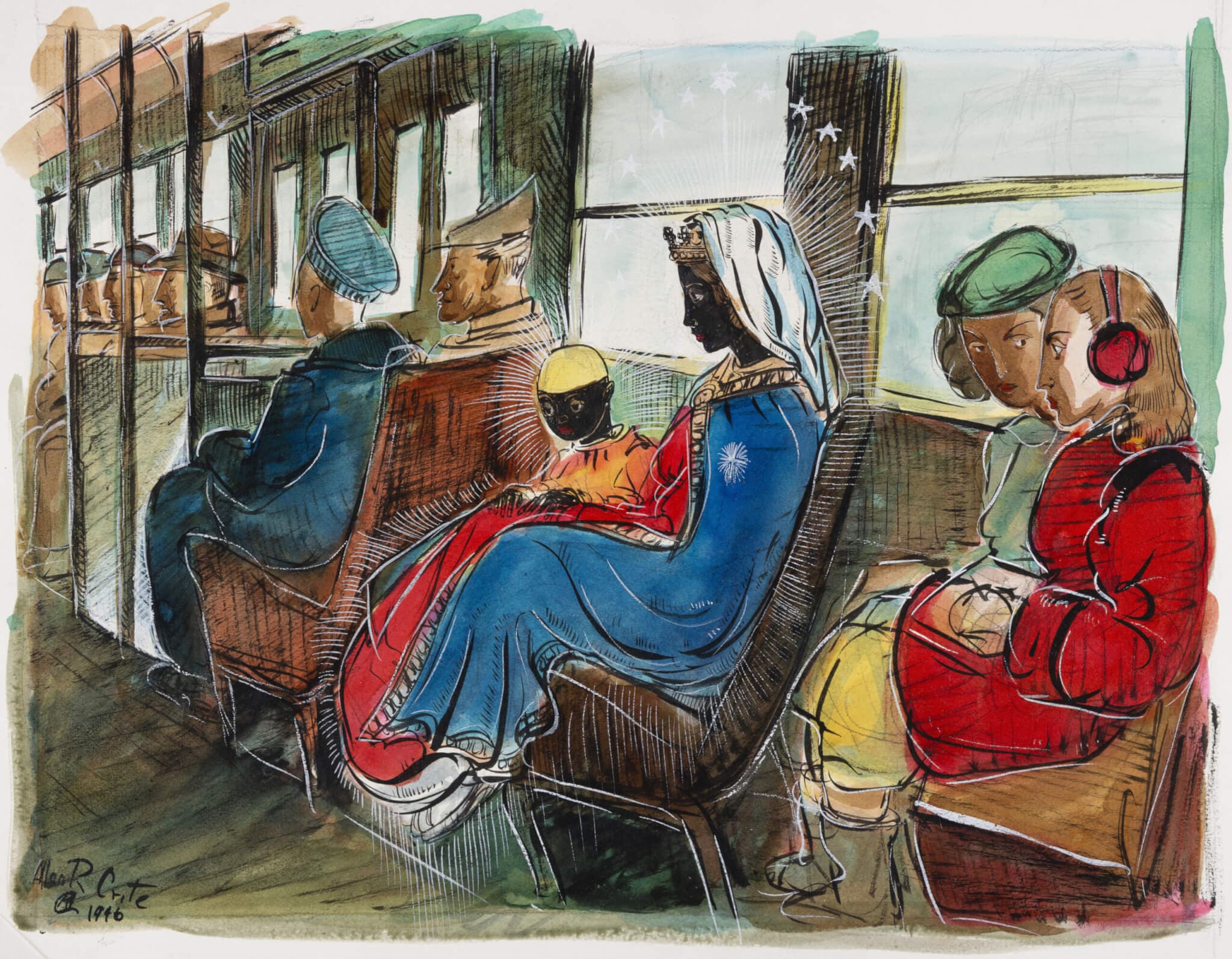
Allan Rohan Crite (American, 1910–2007), Streetcar Madonna, 1946. Watercolor with black ink and white gouache over graphite. Boston Athenaeum, Gift of the artist, 1971. Courtesy of the Allan Rohan Crite Research Institute and Library.
Streetcar Madonna (1946) addresses belonging in another realm, as Crite combines ancient religion and the contemporary by setting the iconography in a trolley car. A Black Madonna and Child occupy the center of the composition. A vibrant blue cloak contrasts with the warm orange, red, and yellow that color her lap, the throne of baby Jesus, and his attire. Lines of light and stars of white gouache surrounding the figures accentuate their holiness. Protecting her child, Mary sits in the aisle seat as two female figures behind them exchange suspicious glances, and the rows of men ahead of them look away obliviously. Here (and in his 1980s series of lithographs, Madonnas of the Subway), Crite uses Black figures to depict the Virgin Mary and Jesus Christ, often with surrounding figures who fail to see the divinity in their midst. As such, Crite’s images nudge a broad audience to tune into the extraordinariness of everyday life. Even more pointedly, his Black ecclesiastical images urge Black people to see ourselves reflected in the biblical stories he so deeply valued. As a scholar of art history, a devout Episcopalian, and a Black man, Crite understood the Christian imagery that he created in alignment with the efforts of European artists to see themselves reflected in the religious iconography that they produced. Rather than aiming to be radical, Crite earnestly sought to offer visual pathways into human history and religion for his Black community members.
The show at the Athenaeum leans into the radicality of the Black figure in Crite’s Madonnas, whereas “Visions of Black Madonnas” at the Gardner more precisely posits the radicality of Crite’s proliferation of such imagery through the use of a printing press and explicitly positions the artist within a long-standing history of Black Madonnas. While prized for its originality, Crite’s creation of Black Christian imagery was not entirely novel—many of his contemporaries, like William H. Johnson, Malvin Gray Johnson, and Aaron Douglas, were all making works of this sort at the time, albeit in Harlem instead of Boston. However, Crite’s treatment of Black Christian imagery differs in his manner of presentation: widespread dissemination using vernacular materials. Around 1955, Crite acquired a Multilith 1250 offset press and began independently designing and printing as many as 1,200 bulletins each week for churches in the US and Mexico. Crite’s desire to see Black figures portrayed in Christian imagery drove him toward the press, as he knew that it offered the opportunity to be seen by the masses, something a single print or image could not achieve. A long vitrine in the Fenway Gallery shares ten examples of Crite’s lithograph and multilith prints of this kind, several of which are in Spanish, a language Crite taught himself.
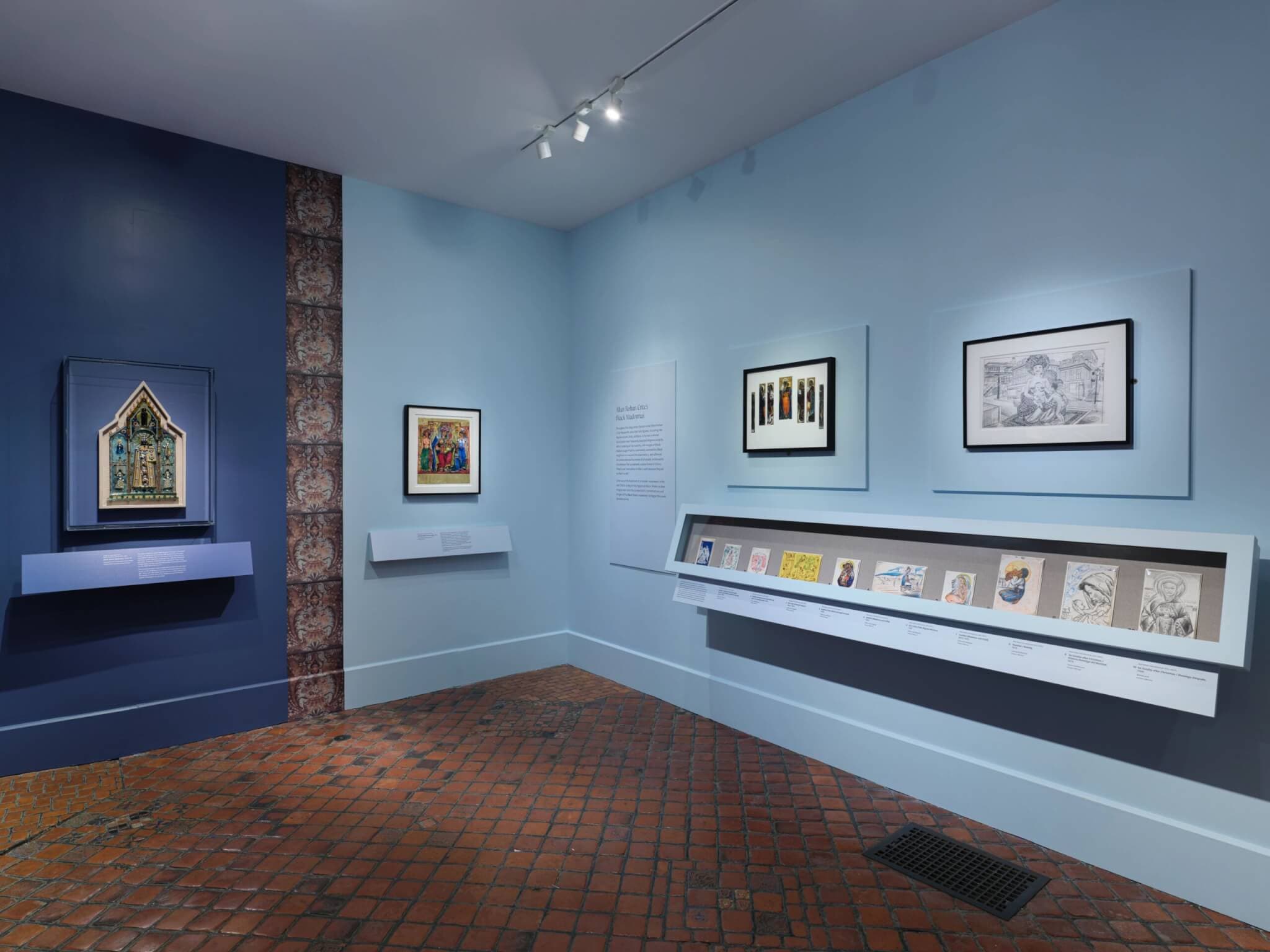
Installation view, “Visions of Black Madonnas,” in Hostetter Gallery, October 23, 2025–January 19, 2026. Courtesy of Isabella Stewart Gardner Museum, Boston.
The academically trained painter’s mid-century turn toward economical reproductions might have troubled philosopher and media theorist Walter Benjamin, author of the seminal essay “The Work of Art in the Age of Its Technological Reproducibility” (1935). To Benjamin, artwork loses its aura, an essential value of irreplaceability, authenticity, and uniqueness, upon being reproduced. Yet for Crite, reproduction unlocked incredible possibilities for his artwork to meet the masses. His liturgical illustrations demonstrate the value of the multiple in service of reaching his community and spreading Christian values. As items people could bring home from church—or even receive abroad, as was the case for recipients of Knot, a monthly newsletter for young members of the military from St. Bartholomew’s Episcopal Church in Cambridge during World War II—Crite’s liturgical illustrations offered many people in many places something tangible to hold and ponder at length.
An offset lithograph self-portrait of Crite, 410 Columbus Ave (1977), is on view at both the Gardner and the Athenaeum—a twin showing made possible by the artist’s investment in printing multiples. During his residency at the Museum of Afro-American History, Crite made An Artist’s Sketchbook of the South End: A Walking Tour about Black People (1977), a compilation of sketches of eleven places significant to his local Black community, which he described as a “recollection so that the Past becomes part of the Present to direct the Future.” In his portrait, set outside of his home, Crite holds a copy of one of his prints that juxtaposes a Malian sculpture and a contemporary model who peers forward at the piece from the background. The model’s presence in Crite’s self-portrait emphasizes his commitment to not merely extracting inspiration from his community but returning the fruits of his practice to them.
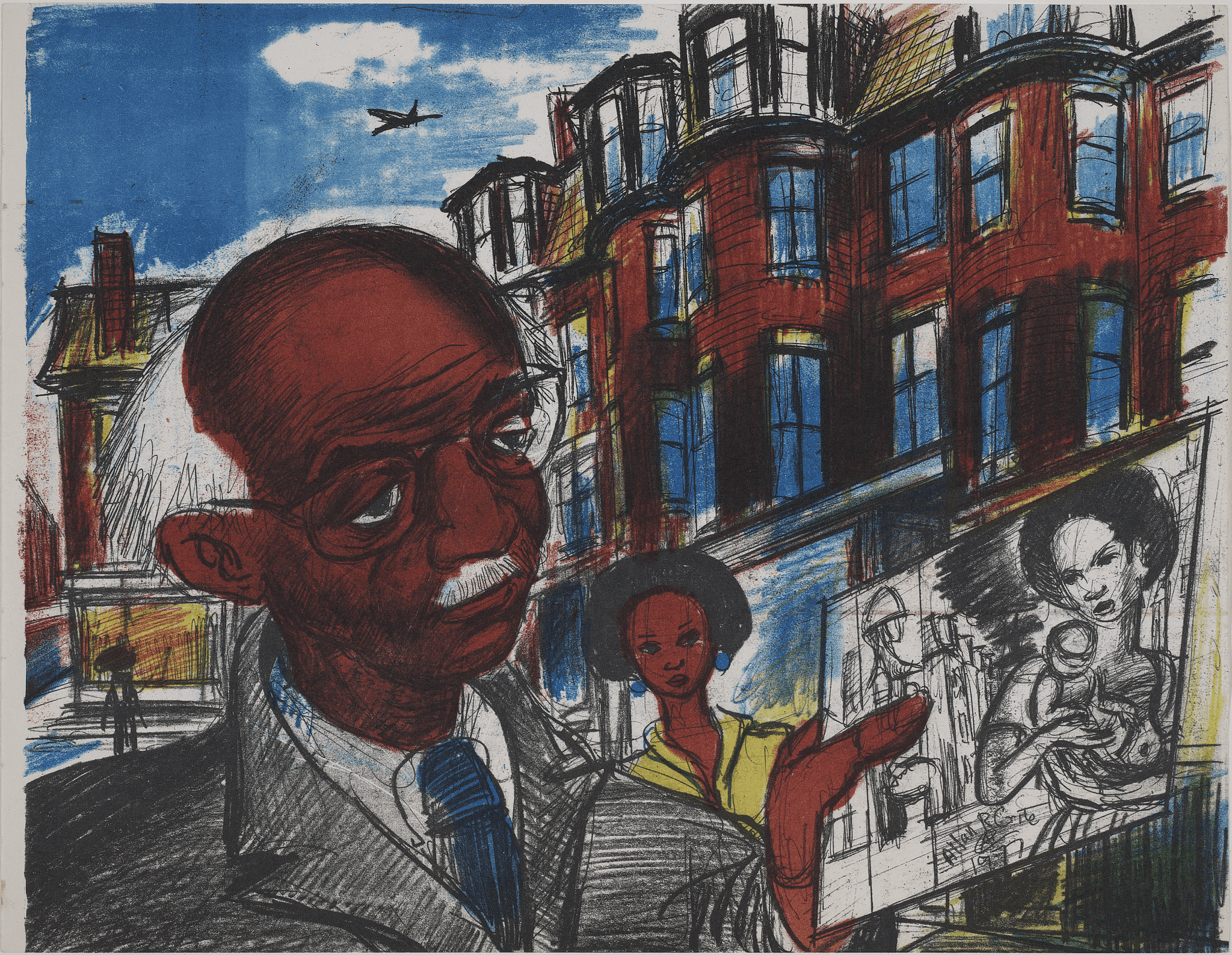
Allan Rohan Crite (American, 1910–2007), 410 Columbus Avenue (from An Artist’s Sketchbook of the South End: A Walking Tour about Black People), 1977. Offset color lithograph. Museum of Fine Arts, Boston. The Living New England Artist Purchase Fund, created by The Stephen and Sybil Stone Foundation. Courtesy of the Allan Rohan Crite Research Institute and Library. Photograph © 2025 Museum of Fine Arts, Boston.
What is uniquely beautiful about this citywide retrospective is the multitude of voices across Boston attesting to Crite’s profound impact. Through recorded interviews, writer Arielle Gray captures many of these voices in the exhibition catalogue. The many threads of the Boston Collective—an artist group that was founded around 1979, led by Crite, and made up of younger artists, including Aukram Burton, Lotus Do, Vusumuzi Maduna (Dennis Didley), Paul Goodnight, Reginald Jackson, Napoleon Jones-Henderson, Susan Thompson, and Johnetta Tinker—echo his driving beliefs in community and accessibility in their work. An installation on the back wall of the Hostetter, curated by Tinker, Thompson, and Crite’s close friend Theordore Landsmark, incorporates the impressions of those who knew Crite well. The wall imitates the close-packed style of display that was typical of Crite’s own home, a four-story spectacle he had effortfully hoped would become a house museum. The installation overflows with lithographs that had been printed in bulk and hand-colored by Crite to situate Black people within global histories of humankind.
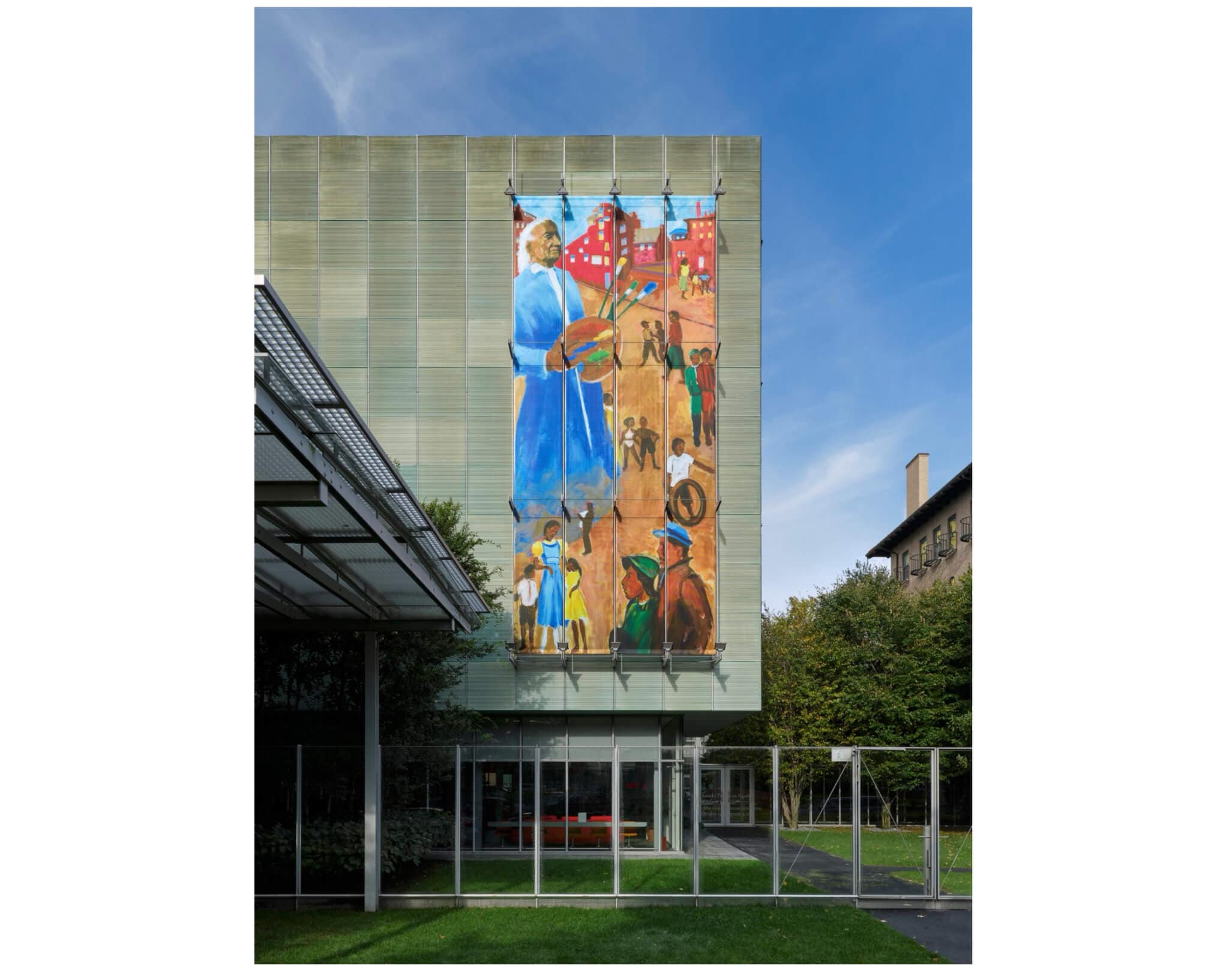
Installation view, “Robert T. Freeman: Allan Crite – American Griot, 2025,” Anne H. Fitzpatrick Façade, October 14, 2025–February 10, 2026. Isabella Stewart Gardner Museum, Boston.
Allan Rohan Crite’s influence on the Boston art scene and enduring Black communities cannot be understated. Members of the Boston Collective remain intimate friends and collaborators. Along the final section of the Hostetter hangs a fantastically colorful quilt made by Tinker and Thompson, Deeply Rooted in the NeighborHOOD, homage to Allan Rohan Crite (2021). Across the panels, joy-filled neighbors play in the snow, sit in the grass, and exchange flowers and glances to communicate the kind of human care that Crite committed to sharing through his art and mentorship. Tinker has a solo show, “We Are Here to Thrive!,” in Boston City Hall’s Fifth Floor gallery, through January 30, 2026. Jackson and Burton reflected on their relationship with Crite during an event at the Athenaeum in November, “Artist-Reporters: Documenting Allan Rohan Crite.” On the Anne H. Fitzpatrick Façade of the Gardner Museum, Robert T. Freeman, too, pays homage to the artist in “Allan Crite – American Griot.” This past summer, Tufts University Art Galleries presented their recent acquisition of Madonnas of the Subway, which will remain on view through January 20. And, with my sense of local history affirmed, I can be found contentedly roaming the streets of my hometown until I identify the church Crite depicts in Cambridge, Sunday Morning (1939).
“Allan Rohan Crite: Urban Glory” and “Visions of Black Madonnas” are on view through January 19, 2026, at the Isabella Stewart Gardner Museum, 25 Evans Way, Boston. “Allan Rohan Crite: Griot of Boston” is on view through January 24, 2026), at the Boston Athenaeum, 410 Columbus Avenue, Boston.