This interview originally appeared in Issue 15, published October 25, 2025. You can read this piece and more by purchasing a copy of or subscription to the magazine here.
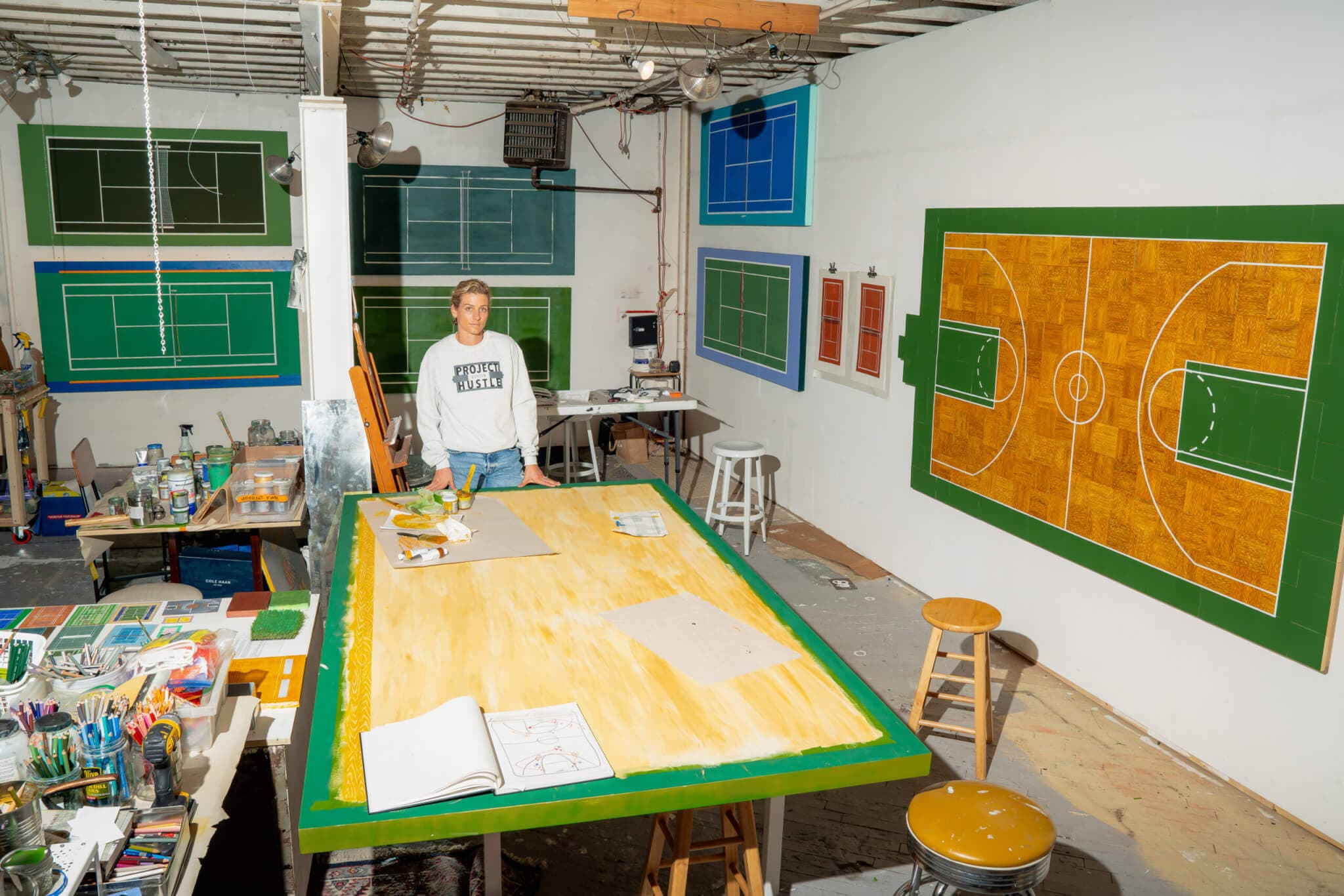
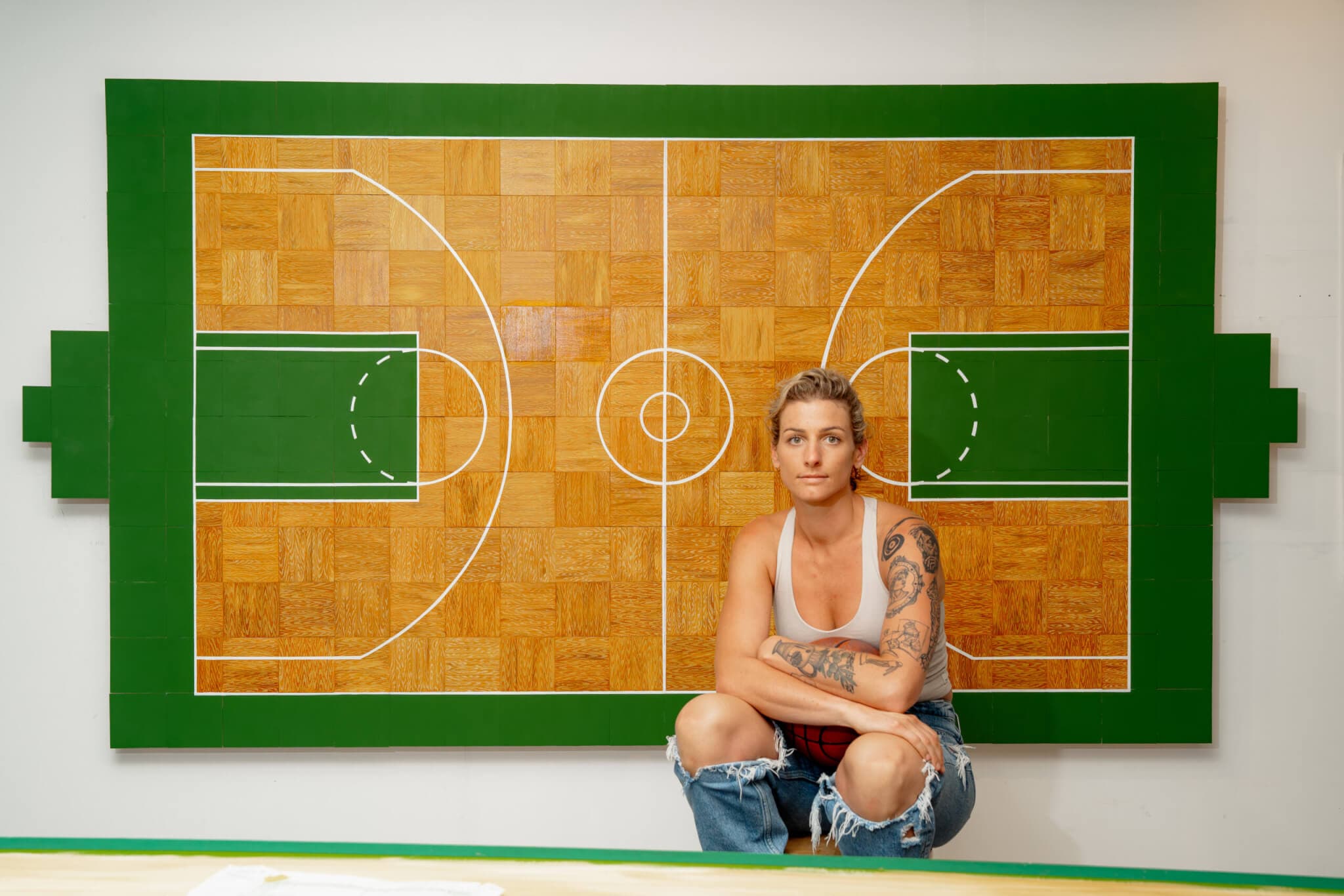
Only two things really mattered in Brooke Stewart’s strict Italian Catholic household—sports and church—and very early on for her, the lines between them began to blur. Sports were a second religion in the Stewart family. Basketball courts were hallowed ground; practice demanded the discipline and solemnity of prayer. “A free throw is a ritual,” she says, sitting on a stool in her South End studio, surrounded by recent works depicting some of the most sacred playing surfaces in all of sports. She gives us an overhead view—omniscient, almost like the eye of God—of the smudgy red clay tennis courts of Roland-Garros, home of the French Open; the faded green grass of Wimbledon; the lavender-and-gold court at the Los Angeles Forum in 1997, on the day it hosted the first-ever WNBA game between the LA Sparks and the New York Liberty. One piece, though, dominates the room: the clover-green parquet floor synonymous with the Boston Celtics, which is now on view through November at the ’Quin House on Commonwealth Avenue.
The rules and requirements of Catholicism never sat well with Stewart, nor did Catholic school—her exodus into the Topsfield, Massachusetts public school system, in fact, may have been the first twinkle of her future as an artist. But ever since she was a little girl, she’s always loved the rituals of faith and the ecstatic spectacle of Mass. And to the extent that she believes in something like a holy spirit, she feels it most powerfully when she’s alone in a gym, getting up shots, or when she’s alone in this studio, painting tiny parquet squares. Stewart scored over 1,000 points at Masconomet High School, just like her big sister did before her, and she got a full scholarship to play Division One basketball, just like big sis and her father did. But her athletic career stalled at William & Mary, and by then, art had long since captured her heart. Now, at age thirty, sports are more like her muse.
On a sunny late-summer afternoon during the last week of her most recent show, “Hail Mary,” at Steven Zevitas Gallery, I paid Stewart a visit. Her enormous eight-year-old Great Dane, Eeyore, flopped on his bed nearby, trying and failing to keep a close watch on us as we spoke about what artists and athletes share in common, how sports moved to the center of her creative practice, and why the Garden floor was parquet in the first place. But first she walked me up a flight of stairs to the back room of her studio, which she’s turned into Project Hustle, a small gallery space where her students can show their work. It’s a practice space of sorts for the unforgiving commercial world, inspired by a valuable lesson she learned in sports that applies just as well to art: Every talented person needs a quiet place to fail so they can learn how to succeed.
The following conversation has been edited and condensed.
Devin Gordon: It feels transgressive to begin an art conversation with a question about sports, but you’re the right artist for it, and I suppose I’m the right interviewer, so I want to ask about the news that Boston is getting a WNBA franchise and what that might’ve meant to ten-year-old Brooke.
Brooke Stewart: Well, the WNBA right now is a totally different place than it was when I was a kid—the first game was in 1997, and that [she points to a collagraph of a basketball floor on the wall behind me] is actually a portrait of that. But my childhood memories of watching women’s basketball was college—I grew up watching UConn, watching Diana Taurasi and Sue Bird. So I don’t know if having a WNBA team when I was a kid would’ve made a huge difference, only because it wasn’t a big deal then. Now it’s a void. We’re missing it. We need it.
DG: I started here because one of your recent and most technically ambitious works is a scaled-down painting of the Garden’s iconic parquet floor, which you recreated by piecing together 247 individually painted five‑by-five‑inch‑square pieces of hand-cut birch wood. Right now, that’s the Boston Celtics’ home floor. But for the next generation of young women in and around this city, that floor will represent a WNBA team, not just the Celtics.
BS: I hope so. Because it’s a symbol of Boston’s resilience and history. The reason we have a parquet floor is because after the war, when they were trying to build Matthews Arena, where the Celtics first played, they couldn’t source enough wood.1 And so they went around and found scraps of Tennessee red oak, and they were like, “Okay, well, we can’t find the wood we need. We’ll just put it together—we’ll figure it out.” And that’s the Boston way for me: “Okay, we’ll figure it out.”
DG: One reason I find it hard to stop staring at this piece is that, for as often as I’ve seen this particular basketball floor, I’ve never actually seen it this way—as in, without the surrounding environment, the crowd, the seats, the people. And something about stripping all of that away, leaving just this simple geometry, brings out a stillness and a peacefulness that surprised me. Suddenly, it looked like church. Take me back to the moment of conception—when and how it occurred to you to recreate this place, in this way, at this scale.
BS: I played basketball in college at William & Mary, and my coach got fired when I was a freshman. It was horrible. I called her and I was like, “Should I transfer?” And she said, “No, this is one of the best schools in the country. You’re not going to be in the WNBA—graduate.” So I said okay, and I stayed, and I sat on the bench a lot and I stared at a lot of floors. The only part I still loved about playing college sports was practice. Everybody hates practice. I loved it.
DG: Honestly that’s a little—
BS: Crazy. I know. But the coach that came in—who was a horrible person—the one good thing he did is he printed out the practice plan and he hung it in the locker room so we knew what we were doing that day. And I would go up and read it, and I’d be like, “This is going to be great.” I got to hang out with my friends and work out. But also, the sound of the court, with the dribbling drills, it’s like a symphony, especially when you’ve got good players going really hard. And then the quietness when nobody’s there … I was thinking: How can I share that feeling?
When the Celtics first started playing, they won and won. But there was something about the way they won, the way they practiced, the way Red Auerbach pieced together the team. So this piece is almost like my little ode to the city. If I had to pick my parents, it would be Auerbach and Agnes Martin, because both of them only see one way. I don’t know if you know anything about Agnes Martin, but she destroyed nine out of ten paintings she made. And Red was similar; he was like, “No, no, no,” until he found his way. This painting took forever. Every little stroke, it was methodical.
DG: The parquet floor piece, which for the record is titled 1952, Boston Garden Parquet, is perhaps the most ambitious example of what seems to be a major new direction in your work—it’s one of several paintings of iconic playing surfaces in sports that you depict like shrines. These are houses of faith, worship, and transcendence. You’ve painted all four tennis courts that host Grand Slams, and your recently concluded show at Steven Zevitas Gallery, titled “Hail Mary”—a nice little double entendre—featured basketball courts with cathedral-slab gray floors and golden rings that evoke the annunciation of Christ.
BS: I wanted to make paintings about women in sports, and the first [women’s] sport that was sponsored was tennis. These guys here [she points to some small paintings on the table behind her] are the studies for the original Grand Slam paintings, and the nets have these little cigarettes holding them up because Virginia Slims was the first sponsor. This year at the US Open, they’re going to have an even bag for the first time—men’s and women’s winners get the same amount. So this was a piece of history I wanted to look at.
DG: These pieces reminded me of action painting—as much about your process of making them, the focus, the gestures, the muscle memory, as what we see on the wall.
BS: A million percent. It’s about practice. It’s about coming in every day and doing your drills. I think athletes and artists are the same. They have the same mind, but their arena is different.
DG: On my way over here, I was trying to think of artists who were also accomplished athletes—there’s not a lot of them! I think it’s you and Matthew Barney. And yet when I think about the degree to which your work, an artist’s work, involves very precise movements and repeated gestures—I’m describing things that athletes do all the time.
BS: A foul shot is a ritual. It’s the same thing. I grew up super Catholic and—
DG: Hang on, this is Boston—what does super Catholic mean here?
BS: Mom goes to church every day. Every day. Still. My grandmother’s ninety-two; she goes to church every day.
DG: I guess it’s working.
BS: Seriously—she smokes butts and drinks and goes to church.
DG: I take it you’re no longer a churchgoer?
BS: No, I don’t agree with it, but I did love the process, the rituals, the memorization. It’s calming. The call and response is very similar to sports. I considered church my first arena, and then I started playing in big arenas with tons of people. Then I stopped playing basketball, and I went to Europe for the first time on my honeymoon, and in Antwerp, all of the Peter Paul Rubens paintings are in the cathedrals where they were intended to live. You see The Ascension of the Virgin where it was supposed to be, instead of plucked out and put in the Louvre or something. So when you walk in, it’s the same feeling you get when you walk into the Garden and you see that floor. It’s a visceral, bodily experience. Billie Jean King talks about it in her book—a feeling of both power and calm.
DG: One notable difference between artists and athletes is the solitude.
BS: Yeah, I’m in here alone a lot. I play games with myself. Like I’ll time myself—how long does it take me to do one of these squares? Or I can’t leave until I finish twelve squares or I make one new baby tennis court. A lot of time-based things. When you walk into my classroom, I have a whiteboard and I write the practice plan—literally the date, the time, what we’re doing. It’s a long class. It’s four hours. And I think it helps people forgive themselves, like, “Okay, well, that part’s over. Let’s move on.” Because you have to be able to fail.
DG: Now there’s an advantage you must have as an athlete turned artist: Sports are all about failure. If you make 40 percent of your three-pointers, you’re a star three-point shooter.
BS: I swear to God that riding the bench in college set me up for the art world. Because when you play D-1, they keep your stats in practice. So let’s say we’re playing James Madison tomorrow—they were our rivals. I could shoot nine for ten in practice and still not play. So I had to be able to tell myself that I did the best I could, that my stats prove that me not playing has nothing to do with me. Here’s my stats from yesterday, and they were the best out of the guards section, but he’s playing somebody else and I can’t change that. I don’t have a gallery show lined up for next year—that has nothing to do with me. I’m doing everything I can every day. And that’s a really hard lesson to learn. It’s really easy to complain. But in sports you really can’t.
DG: You’re hoping to continue this creative direction with an ambitious project conceived for the 2026 Summer Olympics in Los Angeles—what can you tell me about it?
BS: It’s called Home Court, and my goal is to make portraits of female athletes who have created change through their performance in their sport. The game will tell you how good you are. It will speak to the people who don’t believe in you. The paintings are battlegrounds for change. They’d be black and white and hang like a championship banner. And then in my dream world, I would sit with them and have a conversation similar to this. I would ask: Who do you consider your support system? Do you want them in the portrait? And then we’d have a conversation about what you consider your “home court”—that could be your high school gym, or where you first shot a basketball, or where you played in college. And then I would paint a portrait of that arena or field or court or whatever it may be.
I’ve spoken to a couple of people on the Olympic committee, and the issue is they have to support LA artists. So for me to get the Olympic seal, to be part of their programming, it’d have to be at a university gallery or a nonprofit. Or I could go in a completely different direction and maybe hang it at a sponsor’s house, like the Omega house or the Bank of America house or whatever. I don’t care where it goes. I just want it to live.
DG: When did you discover your love for art?
BS: Public school. Mr. Meinelt changed my life. He was my high school art teacher. He is a genius. I still love him till this day. I still talk to him. I didn’t have a lot of friends—again, I was very intense—and I would go eat lunch in the art room, and that’s where I found my community outside of basketball. I started getting better, practicing and practicing, and that’s kind of where I found the connection: If you shoot a hundred free throws, you get better. If you draw the same thing ten times, you get better. That made sense to me.
Kathy Bradford talks about this in a talk she gave for the Portland Museum of Art. She was talking about swimming and how she would be better at the end of the summer than she was at the beginning, and it’s the same thing with painting. It’s a visual progression of achievement, whether it be big or small, and I liked that. When I signed my letter of intent for college, for my basketball scholarship, they had a little party for me in the art room, and my dad came. And Mr. Meinelt told him that I was a way better artist than a basketball player. And I was like, “No way.” And he said, “Watch.” He knew.
DG: What did your dad think of that?
BS: My dad thought he was full of shit. My dad thought that I was the best athlete that ever walked the earth. But I feel like all dads think that their kids are the best.
DG: So your senior year, you’re on the bench, you’re staring at the floor—what are you thinking?
BS: I’m thinking I should have went to fucking art school.
—1 This is true—the post-war housing boom created a nationwide shortage of professionally cut wood.