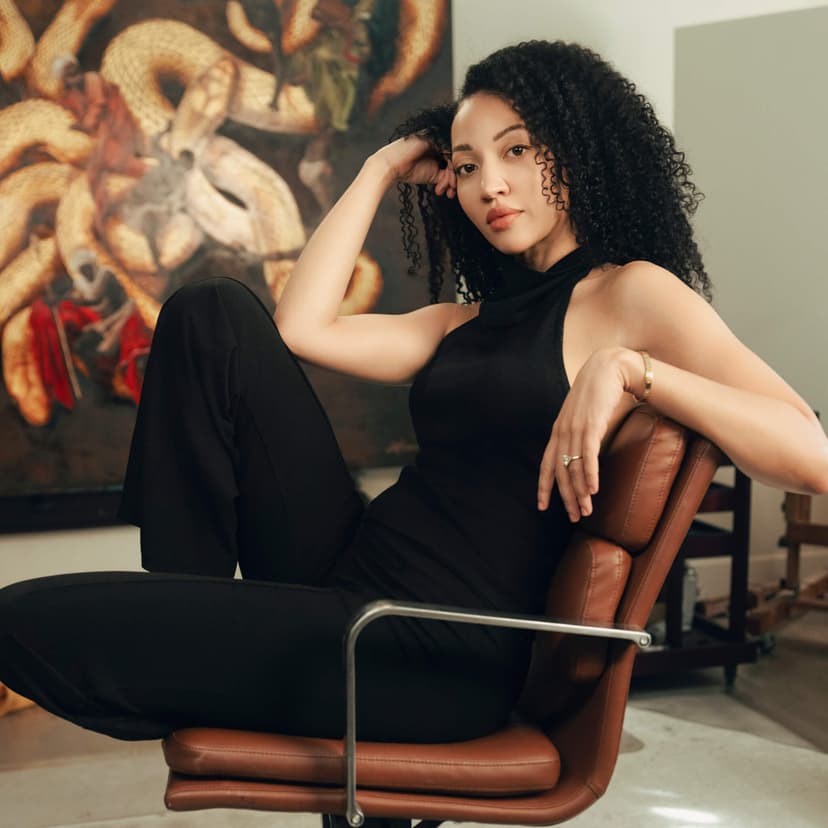
I work alone. I have done so for most of my life, and I suspect it is one of the reasons I became an artist in the first place. My studio has always been a refuge; it’s where I don’t ask permission. That might be why commissions never appealed to me. Once someone begins picturing what they want, the excitement and artistry shift. Or so I thought.
I have often felt as though I live between two selves. One is intuitive, speaking through knowing rather than words. She is drawn toward images and stories that arrive before I understand them. The other self is very human and practical. She worries about bills. She has raised children through this work and knows how hard it is to devote a life to subjects that are often misunderstood.
Around four years ago, in May of 2022, my intuitive self had become unusually persistent. She was pulling me toward sculpture, though I had no idea what I wanted to sculpt or where it could possibly live. I hadn’t sculpted since high school. My studio kept reminding me: “You’re a painter. You have paintings due.” But the feeling would not leave me.
Then, almost two weeks into this private sculpture obsession, I received a call from MASS Design Group about King’s Chapel. They invited me to submit a proposal for a memorial honoring the 219 enslaved people connected to the more than 270-year-old church located on Boston’s Freedom Trail. During the seventeenth through early nineteenth centuries, these known 219, possibly more, were enslaved by ministers or members of King’s Chapel. While the history was fraught, the proposal process offered tremendous creative freedom and promised blueprints and images of the chapel so I could imagine where and how the work might live.
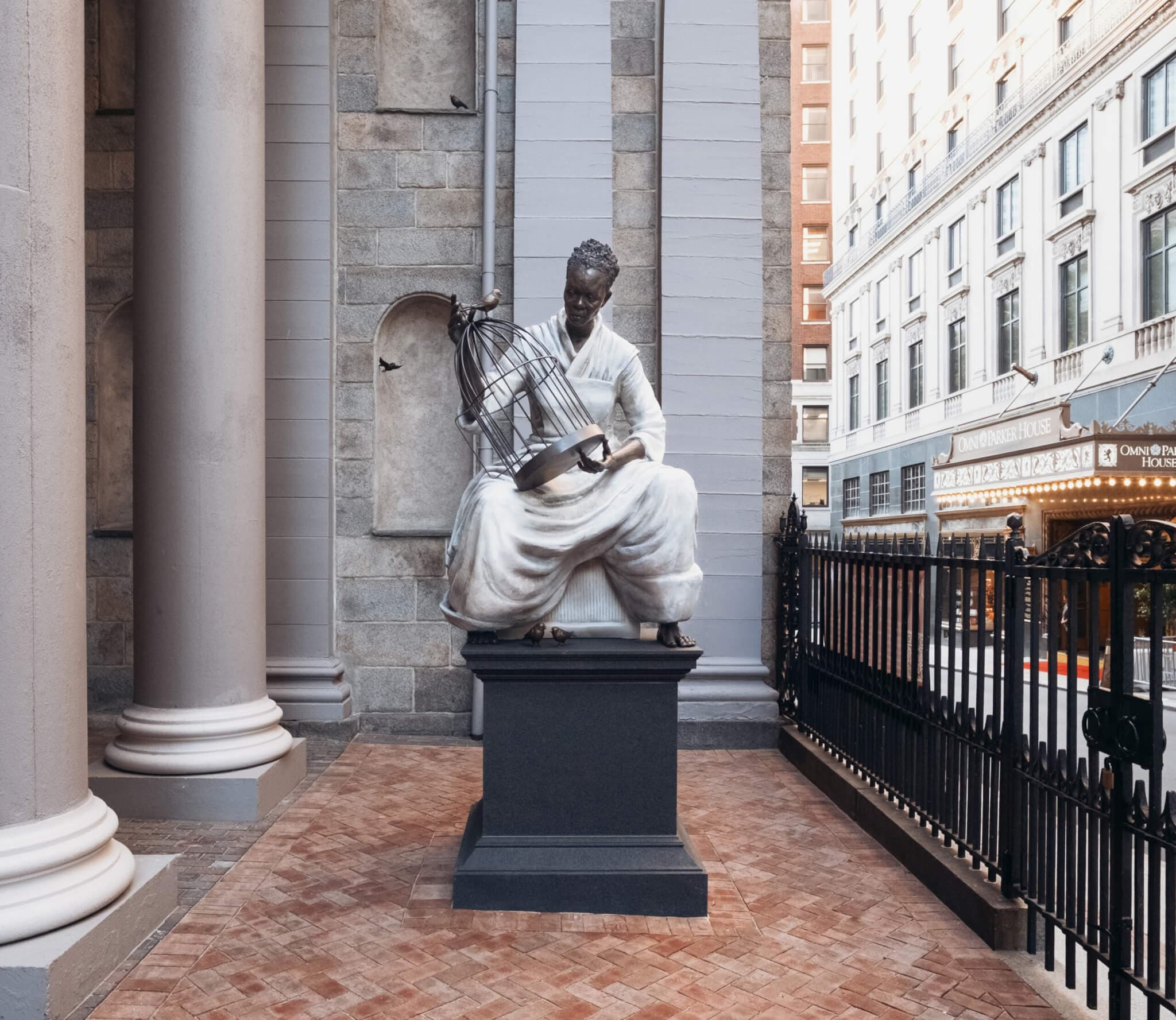
For an artist, this was euphoric. Given my recent fixation, my first thought was sculpture—specifically a monumental figure, a woman, seated and serene. Then I saw the ceiling: a long expanse anchored by a grand pipe organ lit by giant arched windows and a massive, beautiful chandelier. Michelangelo immediately entered the conversation, which was inconvenient because my studio was already skeptical enough about the sculpture. Now I was proposing to paint on the ceiling of one of Boston’s oldest churches. They gently reminded me that I had never completed a sculpture and even shut down the ceiling idea. I submitted both ideas anyway. To put the studio at ease, I submitted a painting proposal too.
A few months later, I received an email: They had chosen not only one of my three ideas, but two: the sculpture—which would eventually be titled Unbound—and the ceiling mural, not the painting. I paused long enough to recognize that my intuitive self knew something long before the rest of me did.
Yet a persistent question lingered: Can I pull this off? At the time, I believed my two selves inhabited separate worlds. My intuitive self planted images while the other created without question or always knowing why. This memorial was about to make that separation impossible.
Accepting a public commission was already outside my comfort zone. Accepting my first monumental sculpture was something else entirely. Here I was being asked to create something permanent out of bronze—a material that doesn’t let you change your mind. I was no longer just listening to my intuitive self. Suddenly there were engineers, fabricators, the King’s Chapel congregation, the MASS Design team, and the Boston community, each with different stakes and perspectives. And I was expected to address their concerns and have answers to all of their questions.
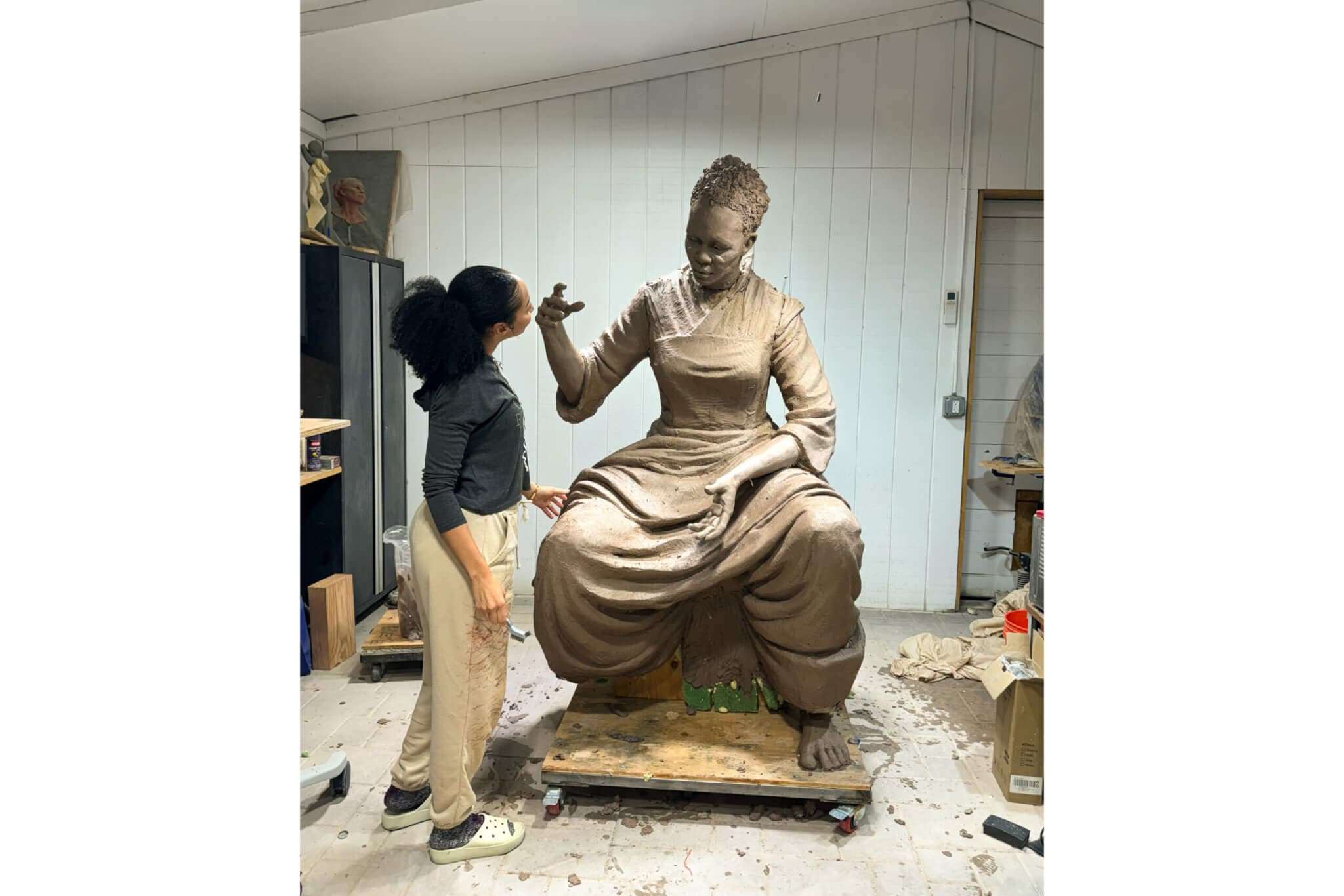
Harmonia Rosales with Unbound in progress, Los Angeles, CA, 2025. Courtesy of the artist.
Defending and translating my intuitive vision before I even began to create it was new for me. In my studio, I never had to explain why something belonged exactly where it was. Now every decision carried consequences: the angle of the body, the position of the hand—even the direction of her gaze—mattered. At the scale of a monument, nothing is done on a whim; the process of moving anything has an engineer attached to it. There were disagreements about whether a monumental figure should even become part of King’s Chapel’s historic architecture at all. The ceiling concept—an assembly of Black and Indigenous people gathered at a trompe l’œil railing gazing down to the pews below—raised concerns. The idea of Black faces overlooking the nave made some members of the congregation uncomfortable. For some, the project represented a change they just couldn’t accept, ultimately leaving the church because of the project.
It was uncomfortable. I found it frustrating at times. I was protective of my energy. But the project unfolded over years, and time did something I hadn’t expected. Interference became familiarity, and familiarity became relationship. That relationship required listening, adjustment, disagreement, trust, and care. There was laughter, joy, and always a very warm welcome whenever I visited King’s Chapel. There was something bigger being nurtured. Those who remained became the people who helped steward the memorial into being. The community brought memory, dignity, and the descendants of lives too often reduced to records, transactions, and numbers.
After years of conversations, the actual making of the memorial became the easiest part of the process. The image itself had come to me early: a seated woman, an open cage, birds moving toward freedom. I knew the gesture before I understood every part of its meaning. But while the sculpture was becoming more specific, its meaning was becoming less exclusively mine.
Although the sculpture didn’t change dramatically from the initial vision, the figure was no longer just a seated woman opening a cage. Her every gesture, the birds, even the cage itself accumulated meaning through their relationships to the histories surrounding them. They became something I could not have produced alone. And for the first time, being a conduit meant something different to me. It was no longer only about receiving an image. It meant allowing that image to pass through other people before it became whole.
But now, I began to recognize something uncomfortable in myself. The human part of me, shaped by the material world and survival, still wanted to call it my monument. My intuitive self had never seemed concerned with possession, so where had I learned this?
The questions expanded into worldviews. I began noticing how often we confuse growth with accumulation—more space, more visibility, more objects, more land, more authority. For most of my career, I had thought about growth as expansion. Unbound was teaching me another kind. The work had become larger in meaning because I had stopped trying to contain it within myself. I started reflecting on the work that had, until this point, defined my career.
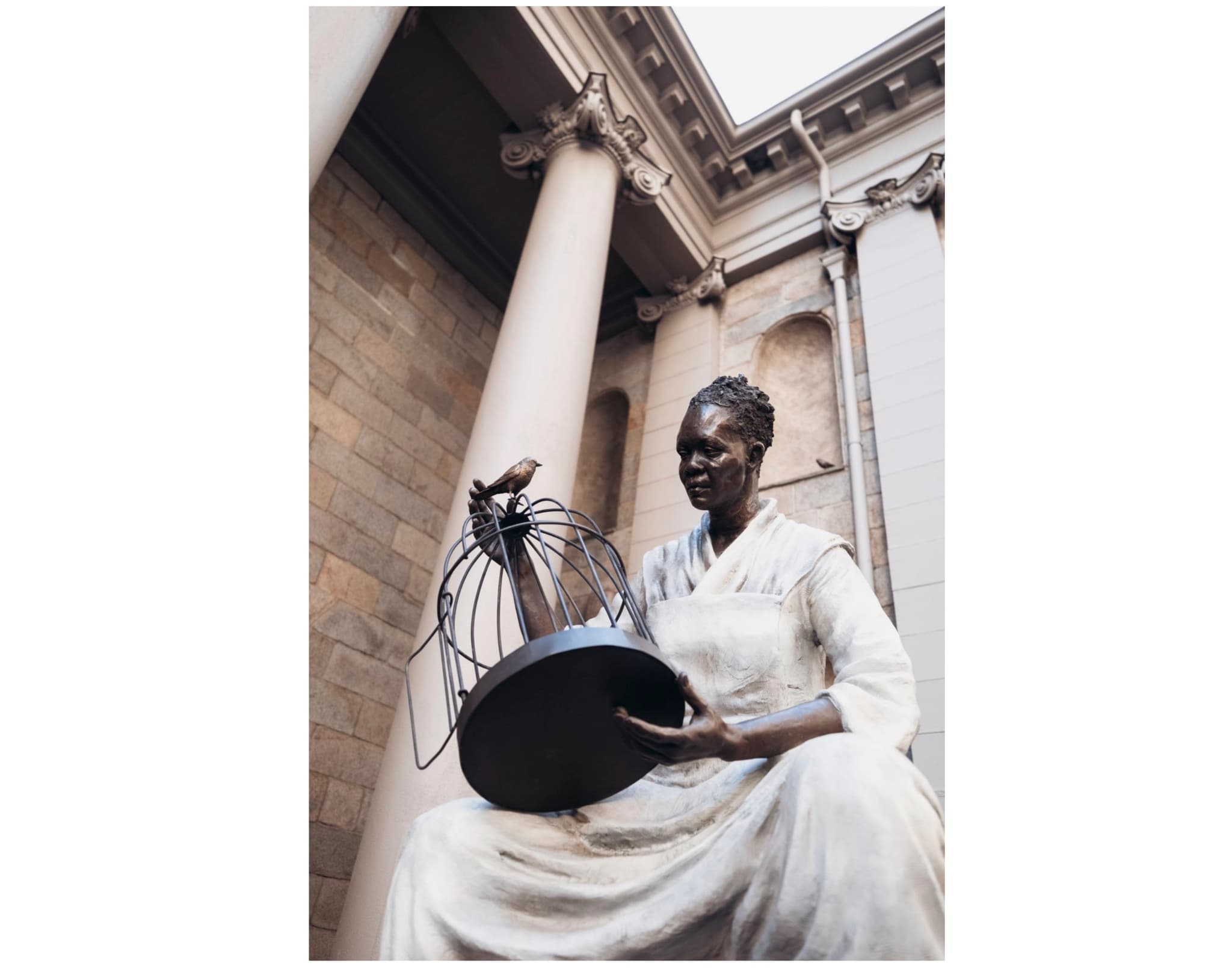
Harmonia Rosales, Unbound, King’s Chapel, Boston, MA, 2025. Courtesy of MASS Design Group.
For years, I described my paintings as being about mythology, history, indigenous belief, and stories that had been pushed to the margins. That remained true. But now I could see another thread running beneath them. I had been painting broken relationships all along: the relationship between humanity and nature, one belief system and another, people and the histories they inherit, power and the people subjected to it. Once I had language for that pattern, I did what I have always done when I want to understand the present: I looked to history.
What I found was that this broken relationship was not accidental. Colonial expansion did more than acquire territory. It helped formalize a worldview in which relationship could be translated into ownership. Land became property, human beings became labor, knowledge could be claimed, culture could be classified, and history could be written by whoever held the authority to record it.
Suddenly, even monuments looked different to me. We place someone or something on a pedestal, declaring its meaning permanent, and then, generations later, tear it down when that meaning no longer holds. We keep destroying and rebuilding the object. But what if the real problem is the relationship underneath it?
That question haunted me as Unbound was being installed. I watched this thing that had once existed only as an image in my mind become bronze, then architecture, then part of a church that had been standing long before I arrived and would remain long after I left. And somewhere in that process I began to understand what I thought a monument could be. Perhaps the future of monuments does not lie in giving history another final verdict.
Some monuments were created to reinforce power and exclusion, and questioning them is necessary. But I began wondering whether there was another possibility. What if a monument did not simply tell us whom to honor or condemn? What if it helped us reconsider our relationship to history itself?
I think about The Embrace (2023), not far from King’s Chapel. What I love about the monument is that the individual body disappears. We recognize the embrace between Martin Luther King Jr. and Coretta Scott King, but only their embrace is monumentalized. The meaning becomes larger than two people. It teaches us that humanity is not sustained by the individual alone, but by the way we hold, support, love and care for one another. That way of creating a monument interests me.
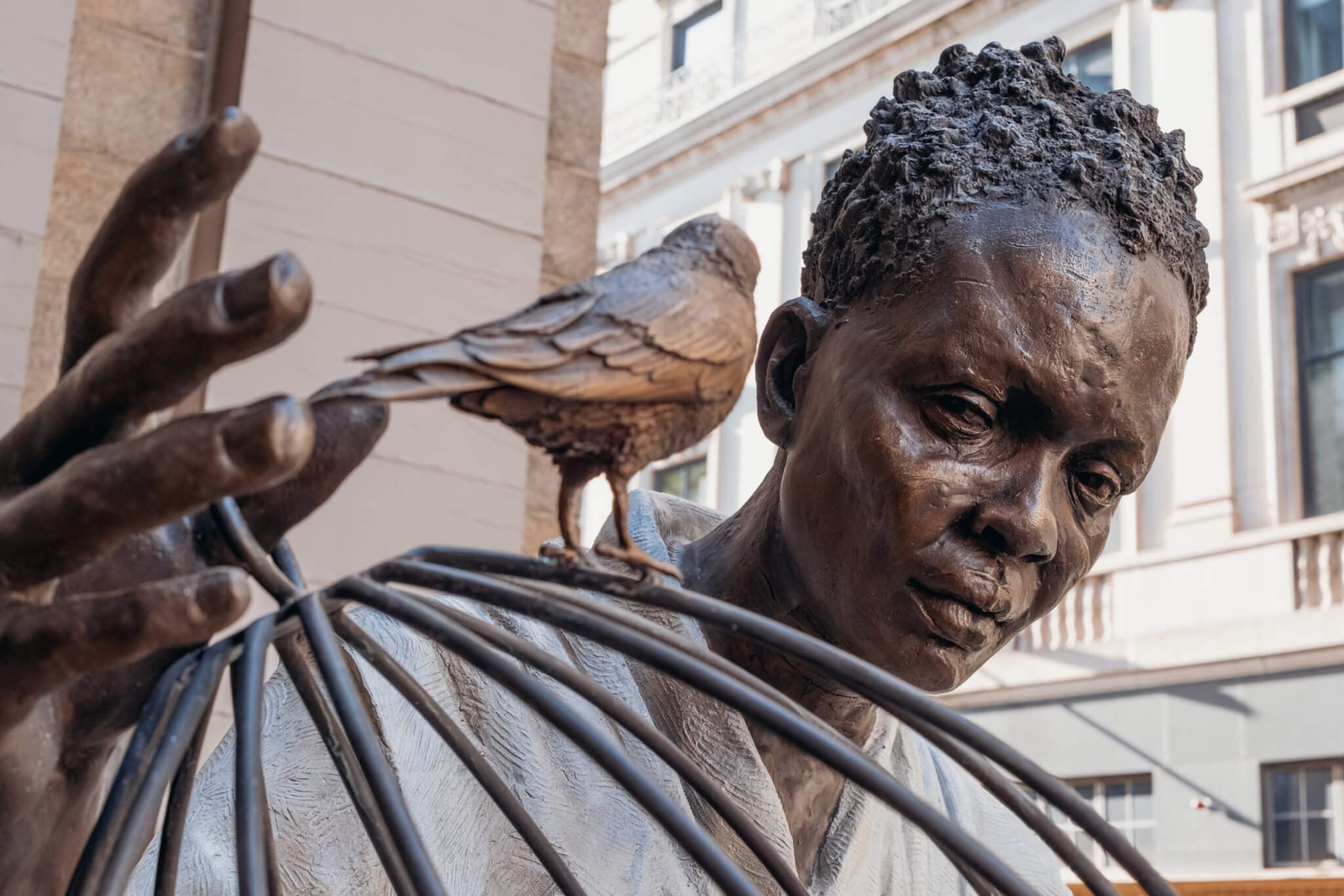
Harmonia Rosales, Unbound, King’s Chapel, Boston, MA, 2025. Courtesy of MASS Design Group.
The woman seated at King’s Chapel is not one of the 219 enslaved people whose histories prompted the memorial. She cannot be. I did not want to invent a face, a personality, or an emotional narrative and then place it onto people whose individual stories we do not fully know. The historical facts are already powerful enough. People of color were separated from the white congregation below, listening to sermons and participating in a religious world that did not reflect their own histories or experiences.
I did not want to rewrite that past. I wanted to ask what we do with it now. With Unbound, every aspect of the figure represents freedom. I first understood those symbols intuitively. Four years later, I understand them differently. She’s not there to absolve the church of its history, nor is she there to condemn everyone who enters it. She holds the history without allowing the history to be the final condition of the space. For me, she became a resting place, not a place where history is put to rest—I don’t think we have that luxury—but a place where we can rest with history long enough to understand it. She’s a place where descendants, congregants, visitors, Bostonians, people who have no connection to Boston at all, can stand in the same space and encounter what happened without being told that they must experience it in precisely the same way.
That, to me, is where healing begins. It begins when we can tell the truth and remain in relationship with one another after telling it. And Unbound is only the first part of that relationship. My next work at King’s Chapel moves upward to the ceiling.
In many ways, this feels like round two, only now I know what to expect. I know the concept will be questioned, challenged, and deepened through the same collaborative process, and this time I welcome it. I’ve learned that anything worthwhile takes time to become what it is meant to be.
The enslaved congregation had once been confined to the upper pews of the church, and I kept returning to the contradiction of a beautiful structure that also functioned as a cage. For the ceiling, I imagine that cage being opened, the roof giving way to sky, birds flying upward, and figures evoking those once pushed to the margins of the space now able to look back into it.
It is not my attempt to claim that their spirits are literally watching the church. It is a visual way of saying that the relationship has changed. The past is no longer shut away in an upper pew, unable to speak to the space below. We are looking back; they are looking toward us. History and the present are finally being permitted to occupy the same room.
Unbound was never intended to be a finished sentence. It is a phase in one of a larger transformation of King’s Chapel. The sculpture opens the cage, the ceiling opens the architecture. Together, I hope they allow the church to remain in active relationship with its history rather than treating that history as something settled.
Maybe that is what I want from monuments now—not objects that conquer space only because they are large enough to do so, not permanent declarations that insist history has been solved. I am interested in monuments that create relationships between people and history, between institutions and communities, between those who came before us and those who have yet to arrive.
Which brings me back to my studio where I write this. I still work alone, but the room no longer feels quiet and closed. My quieter self still brings me the image; my human self still has to figure out what to do with it. The difference is that I no longer believe either of them can finish the work alone. What exists between my two selves now is not hierarchy, but relationship.
Interesting, I thought I was making my first monument. What I learned was how to leave the door open.