It was easy to get swept up in the hype over April’s stampede on Huntington last week. But the runner—nay, streaker—causing this year’s guffaw wasn’t here for the marathon.
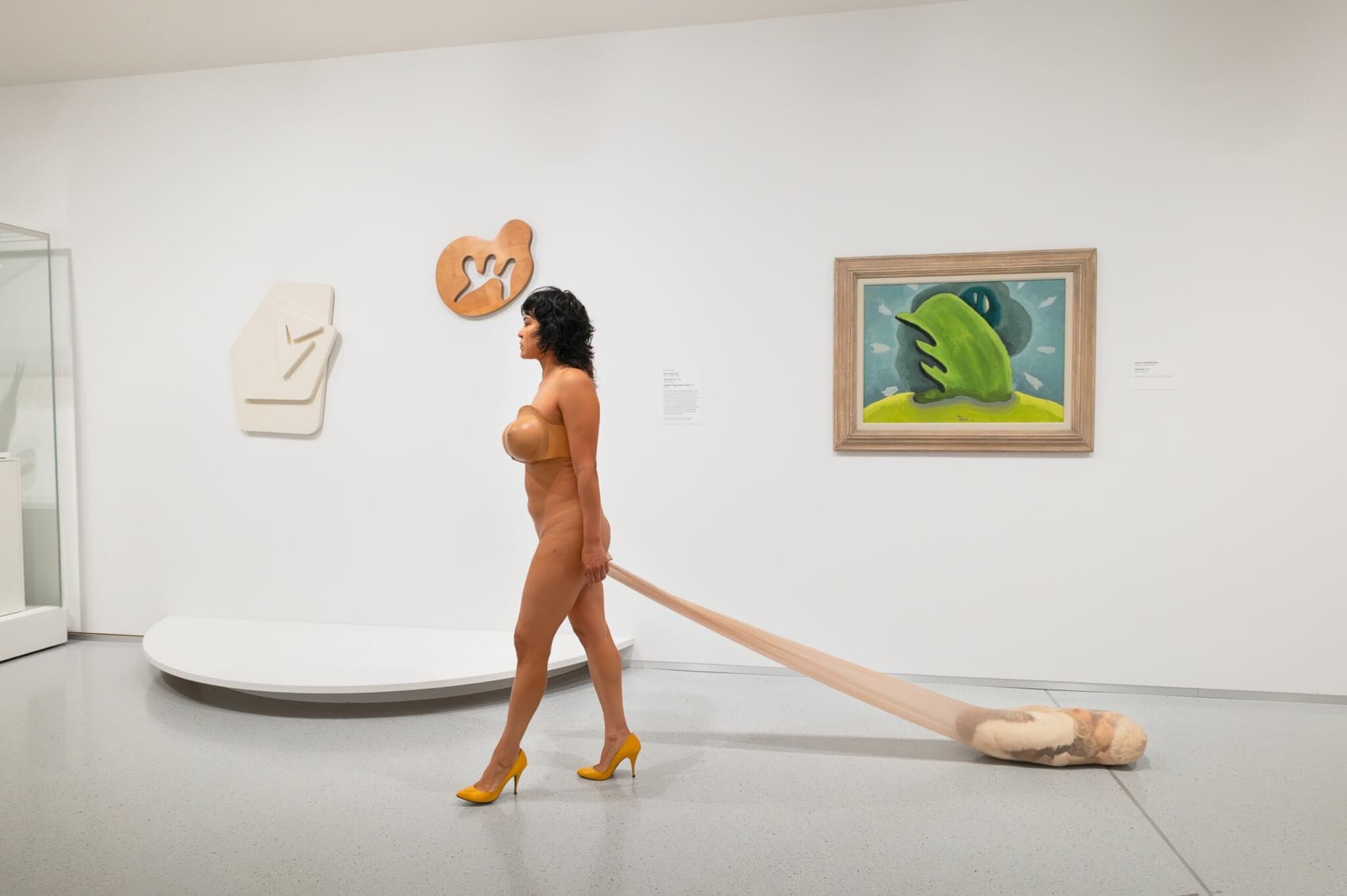
Artist Xandra Ibarra’s performance work Nude Laughing, part of the MFA Boston’s exhibition “Subvert, Repair, Reclaim: Contemporary Artists Take Back the Nude,” attracted a considerable crowd during the museum’s third Thursday programming. An MFA Instagram post featuring images from Ibarra’s performance has garnered more than 1,400 comments as of last Friday, with many debating the work. Most of the commenters did not attend the performance, and at least a portion of them are probably bots. However, the fact that the piece has inspired this much debate well outside the usual channels of art media is irrefutable evidence of the work’s success. It’s been delicious to see this much spirited conversation provoked by the artist cackling down the marble halls of New England’s preeminent encyclopedic museum. Her nakedness in the performance emphasized her subjectivity and the hypocrisy that women’s bodies are permissible when depicted in a work of art but vulgar in flesh and blood. Grounded in this standpoint of intersectional marginalization as a Latinx woman, Ibarra’s artistically weaponized laughter highlighted the ridiculous contradictions at the heart of the racial, classist, and misogynistic injustices required to build institutions, such as the MFA, that presume a disembodied voice of institutional authority.
Birds, bees, and institutional critique aside, spring also means budget season. This week, we began our coverage of Mayor Wu’s proposed fiscal year 2027 budget, which includes a hefty cut to the Mayor’s Office of Arts and Culture (MOAC). But that is the city’s budget. The state budget, which also funds the arts, was reviewed by the Massachusetts House Ways and Means Committee, which released a spending plan that included a 5 percent increase in Mass Cultural Council’s operating budget, slightly outpacing the 3.3 percent inflation rate.
A 5 percent increase is not a cut. Yet within the context of an affordability crisis, which is provoking even well-capitalized, culture-producing corporations such as Disney subsidiary Marvel Entertainment to decamp from the United States (citing cheaper labor and universal healthcare) and economists warning of the possibility of the US teetering into a stagflation crisis, a 5 percent increase for local arts and culture seems more like maintaining the status quo than a cause célèbre. Meanwhile, evaluations of innovative programs, such as Ireland’s experiments to expand state support for the arts, have shown positive economic and governance outcomes.
Local budget season is also the time to flag potential risks in advance. About 25 percent of state revenue comes from federal subsidies. Massachusetts has already lost significant funding under the Trump administration. This remaining revenue and mail-in voting rights are now both under threat by an executive order signed by President Trump on March 31.
Framed as an election security measure, this order holds states and the will of the people ransom by making federal subsidies and mail-in voting contingent on states submitting lists of all citizens to the Department of Homeland Security. Only people on the list will be eligible to receive mail-in ballots. Numerous historical precedents illustrate why this is dangerous. As the midterms approach, it will be important to watch whether this order is blocked, as with prior attempts to limit voting rights through proof-of-citizenship requirements.