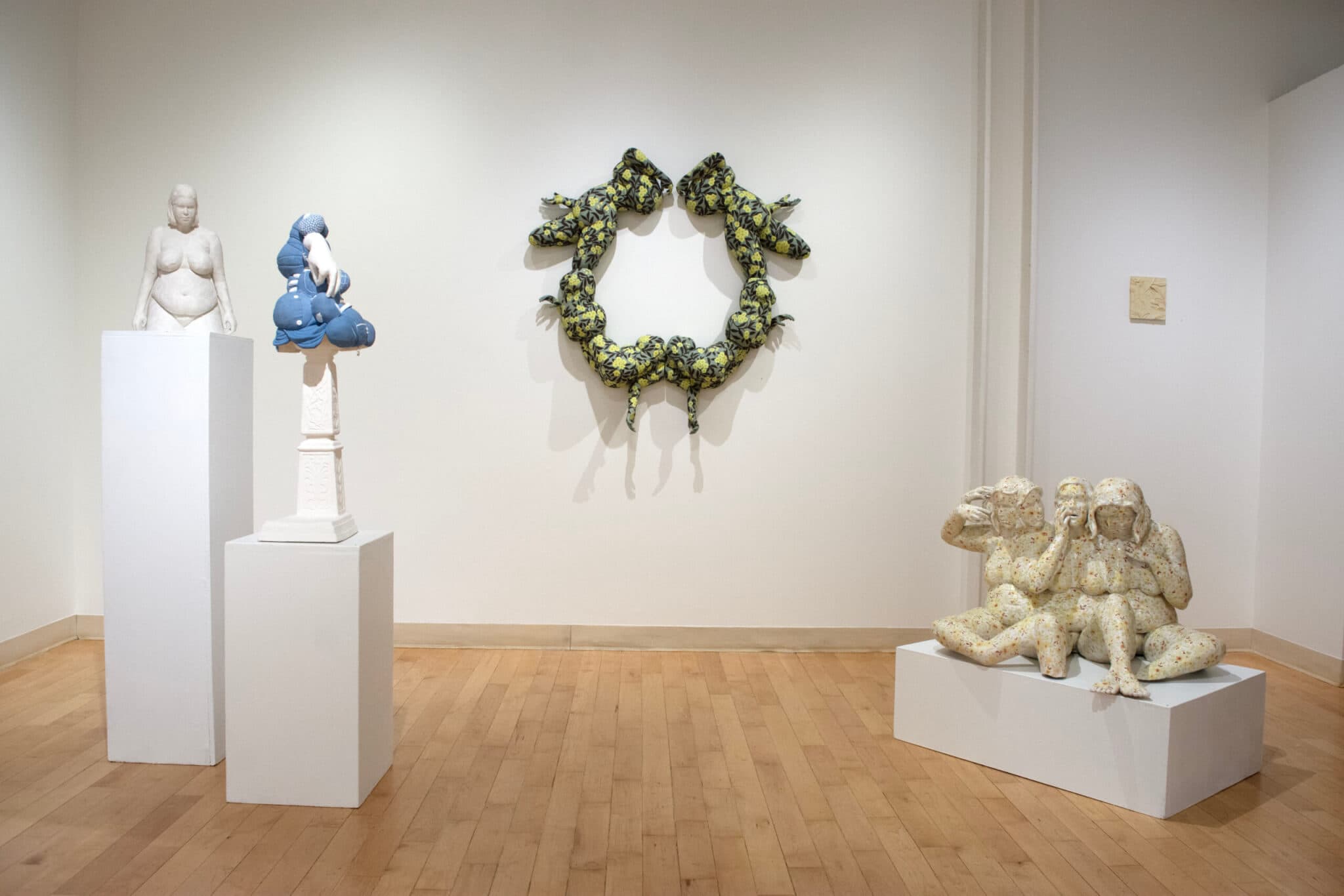
Corran Shrimpton’s “Flesh Flowers,”1 on view at Bromfield Gallery through February 1, is an unnerving, yet deeply compelling, exploration of female bodies and the control they face—both at the hands of societal beauty standards and the very people occupying these bodies. In the small square room, ceramic sculptures of distorted bodies rest on plinths to the left and right, varying from less than a foot tall to nearly life-size. Others, both of a similar bodily nature and in the form of ceramic tiles, are affixed to the wall.
It is worth noting that while bodies are not intrinsically gendered along binary lines, Shrimpton’s artist statement makes clear an intention to specifically address the experience of women, thus informing my gendered interpretation of these works. She explains that the exhibition “reflects on the persistent pressures that shape how women move, present, and see themselves—both historically and today.”
There is a dissonance between the grotesque contortion of the bodies and their ornate decoration. The sculptures’ surfaces are adorned with glazes of soft pink, blue, and yellow, along with floral patterns, inspired from Victorian wallpaper, in the same colors. Strings of pearls and dainty glass beads dangle from the pieces. These details echo the ways many women seek to enhance their physical appearance. While this is a practice that can foster confidence or comfort for some, the bodies’ distorted positions in this exhibition do not elicit such positive feelings. Instead, the contrast is unnerving and illuminates the darker side of beautification processes, particularly in the context of societal pressure to pursue unattainable beauty standards. The bodies depicted here are coated in delicate beauty, but their suffering is not truly masked, creating an unsettling juxtaposition.
Shrimpton reinforces these ideas in her artist statement, noting that the use of Victorian floral patterns is reminiscent of “decorative surfaces hiding invisible harm” because those very same wallpapers were laced with arsenic. It is with this backdrop, and an understanding of the long history of physical constraints placed on women—from a lack of political power to a lack of control over their own bodies and lives—that Shrimpton externalizes the harm of modern day beauty standards.
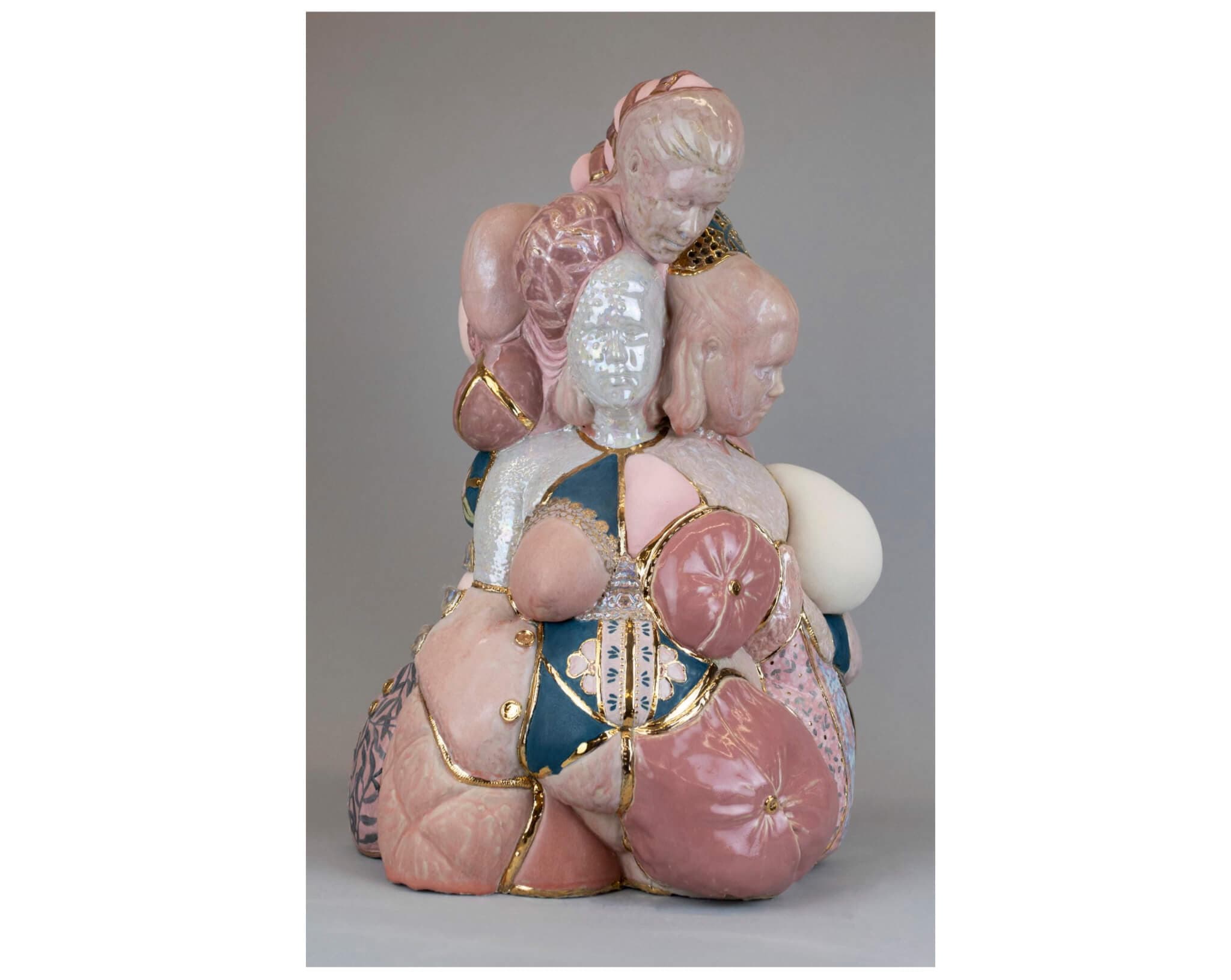
Self-Fastening (2023) is a direct example of beauty overlaying distress. Bodies stack on top of each other, blending until they are essentially unrecognizable, except for a disconcerting number of heads. What remains is a pile of bulges and blobs covered with markers of delicate femininity: pastel pinks and floral patterns, all laced with gold trim. This heap of combined bodies seems to be a heavy burden, weighing each other down. They evoke the desperation of a drowning person, who inadvertently pushes down others’ bodies to save themself—an unfortunately apt metaphor for aspects of womanhood. Some of the most arduous defenders and perpetrators of gender roles and physical beauty standards are women themselves, reinforcing the same restraining narratives that are being imposed on them and tearing their peers down in the process. Ultimately, everyone is harmed when femininity and beauty are defined so rigidly, leaving all women in a joint unjust circumstance.
Bodies melding into one is a visual repeated throughout the exhibition, as limbs, breasts, and heads morph into singular entities. It is an uncomfortable, unnatural depiction that evokes a loss of autonomy and individuality. Simultaneously, there is a notable sense that this is not an individual struggle but an oppression that binds people together.
The standard of layering bodily adornments or making alterations to satisfy societal expectations—rather than a personal desire for self-expression—can strip away one’s identity and sense of self. Pattern Recognition (2025) confronts this disturbing reality of conformity. Attached to the wall, the large sculpture takes the form of a symmetrical near-circle created from bodies bent in abnormal configurations that would certainly be physically painful. Out of context of this exhibition, the form would hardly be identifiable as human bodies. Their individual features are difficult to distinguish and are further disguised by a repeated pattern of yellow flowers and black leaves on the surface. They are no longer distinct individuals.
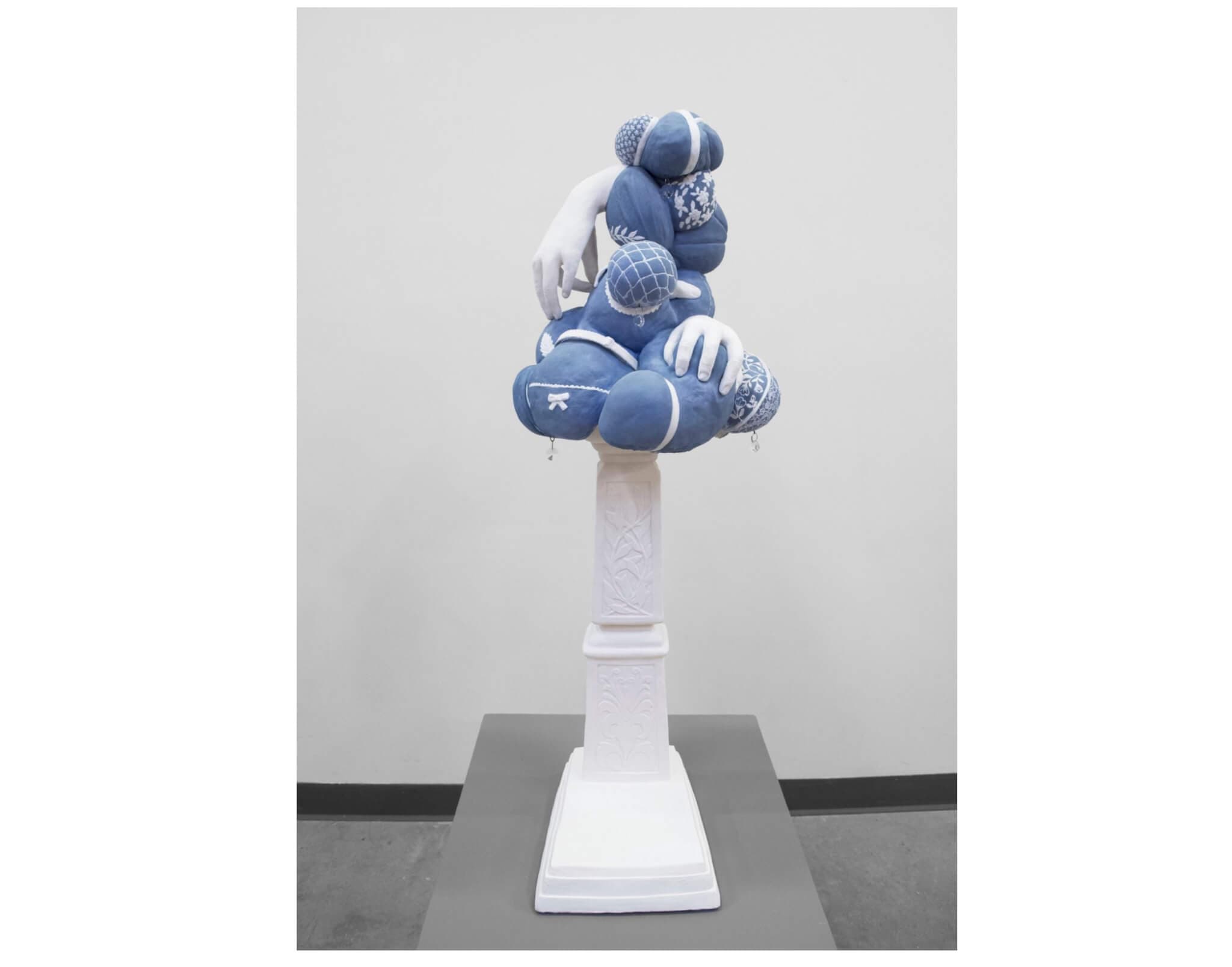
Blueprint (2025) is a conglomeration of blue limbs twisted around each other atop a pedestal. Large white hands grow out of the sculpture, grabbing at itself—an effect generated by the shaping of the hands and indentations in the spots where the fingertips touch. Perhaps these hands are acting as a protective measure, desperately holding onto the body in an attempt to reclaim self-ownership—or perhaps, more cynically, they are someone else’s hands, predatorially grabbing as they enact control and constraint.
While much of “Flesh Flowers” fed into my own pessimism—particularly in the context of a dwindling online body positivity movement and a regression of societal obsession with female thinness—there is room left for resistance. In both Hysteria 3 and Hysteria 4 (both 2024), ceramic relief sculptures depict figures protruding from tiles covered in vines and leaves. They may be trapped, but they cannot be fully restrained.
“Flesh Flowers” interrogates the pressures of idealized appearance expectations in a manner that effectively calls out their hypocrisy and harm. I am left curious about how these themes could be expanded further in this style, beyond only traditionally feminine beauty standards. Shrimpton offers a broad lens to indiscriminately consider all women’s relationships with their bodies, but I am interested in what could be uncovered in a less overtly binary approach, where the amorphous bodies are not labeled explicitly as women. The specific experiences of trans and nonbinary people feel particularly salient when considering restrictions placed on the body and on how one presents or moves through the world.
Ultimately, “Flesh Flowers” produces a lasting somatic uneasiness that forces confrontation with the reality of gendered appearance expectations and obsessions. As the bodies become abstracted and forced into unnatural forms, the damaging effects of beauty standards are not just seen, but felt.
—1 Shrimpton is a winner of the SOLO competition, which awards two New England artists with first-time solo exhibitions at a commercial gallery. Shrimpton’s work is being shown alongside her fellow SOLO 2026 winner Emily Shedlock’s ”Among Shadows.”
“Flesh Flowers” is on view through February 1, 2026, at Bromfield Gallery, 450 Harrison Avenue, Boston.