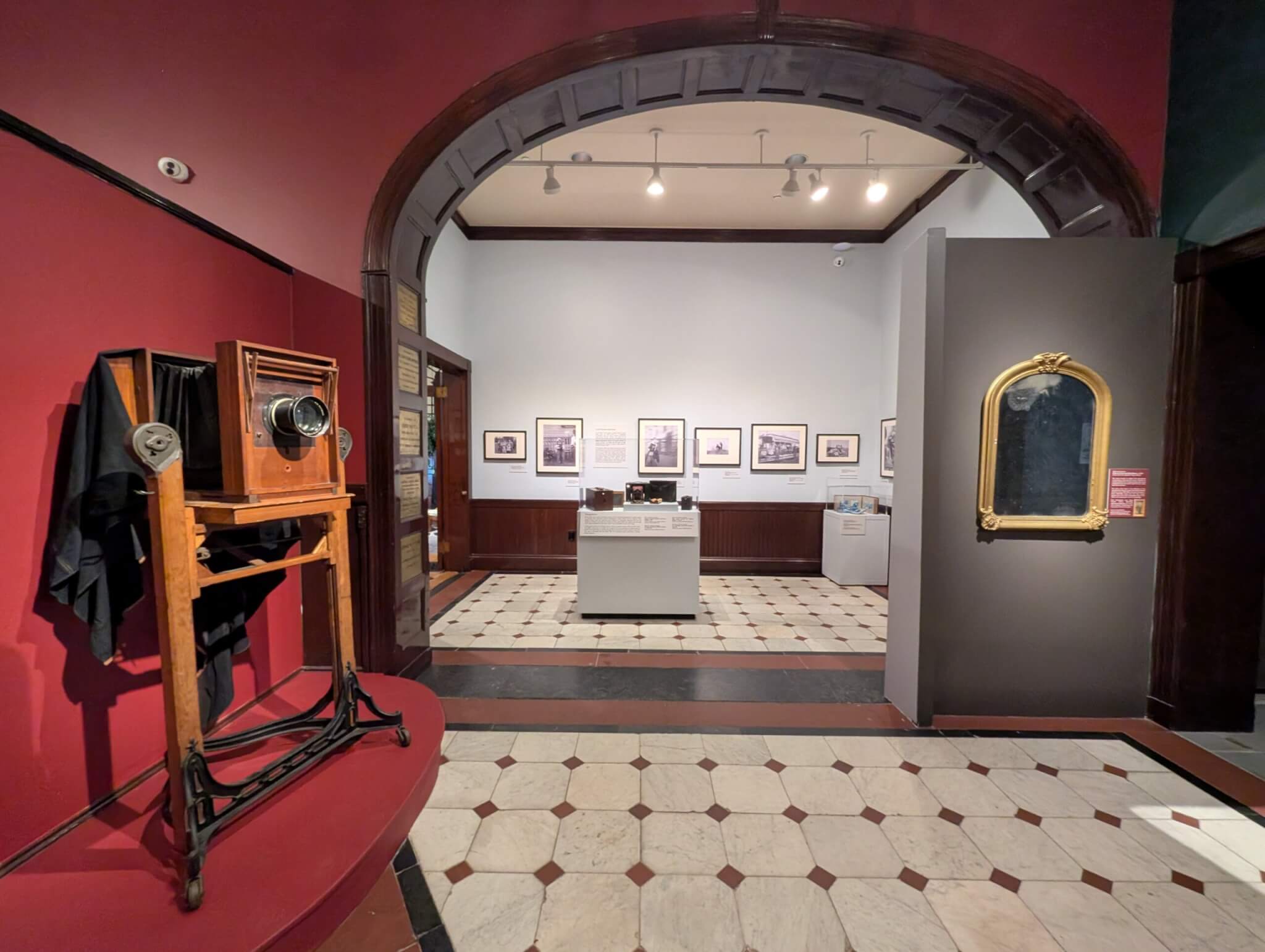
Before there was photo, there was paint. So “Look Pleasant, Please: Early Portrait Photography in New Bedford,” the New Bedford Whaling Museum’s current exhibition, begins with an oil painting. It’s Rembrandt Peale’s 1828 portrait of William Rotch Jr., a New Bedford whaling magnate whose wealth was enough to afford this rendition in three-quarter profile. Each brushstroke is a choice, and Peale chose (or maybe rather was instructed?) to construct Rotch’s character through wizened lines of wrinkles, folds of ironed fabric, and a dot of twinkling white to enliven each eye.
The New Bedford whaling industry, which Rotch captained, quite literally kept the lights on for nineteenth-century Americans, but as the century progressed and new technologies crossed the Atlantic, Americans quickly became enamored with the business of capturing light instead of just creating it. By 1841, the daguerreotype arrived in New Bedford from France, and a new image of the area and the people inhabiting it appeared. Pulling from the museum’s collection of over 200,000 photographic objects, “Look Pleasant, Please” presents the history of American portrait photography from 1839 to 1900, tracing the development of photographic technology alongside the development of the American individual and what it means to look pleasant.
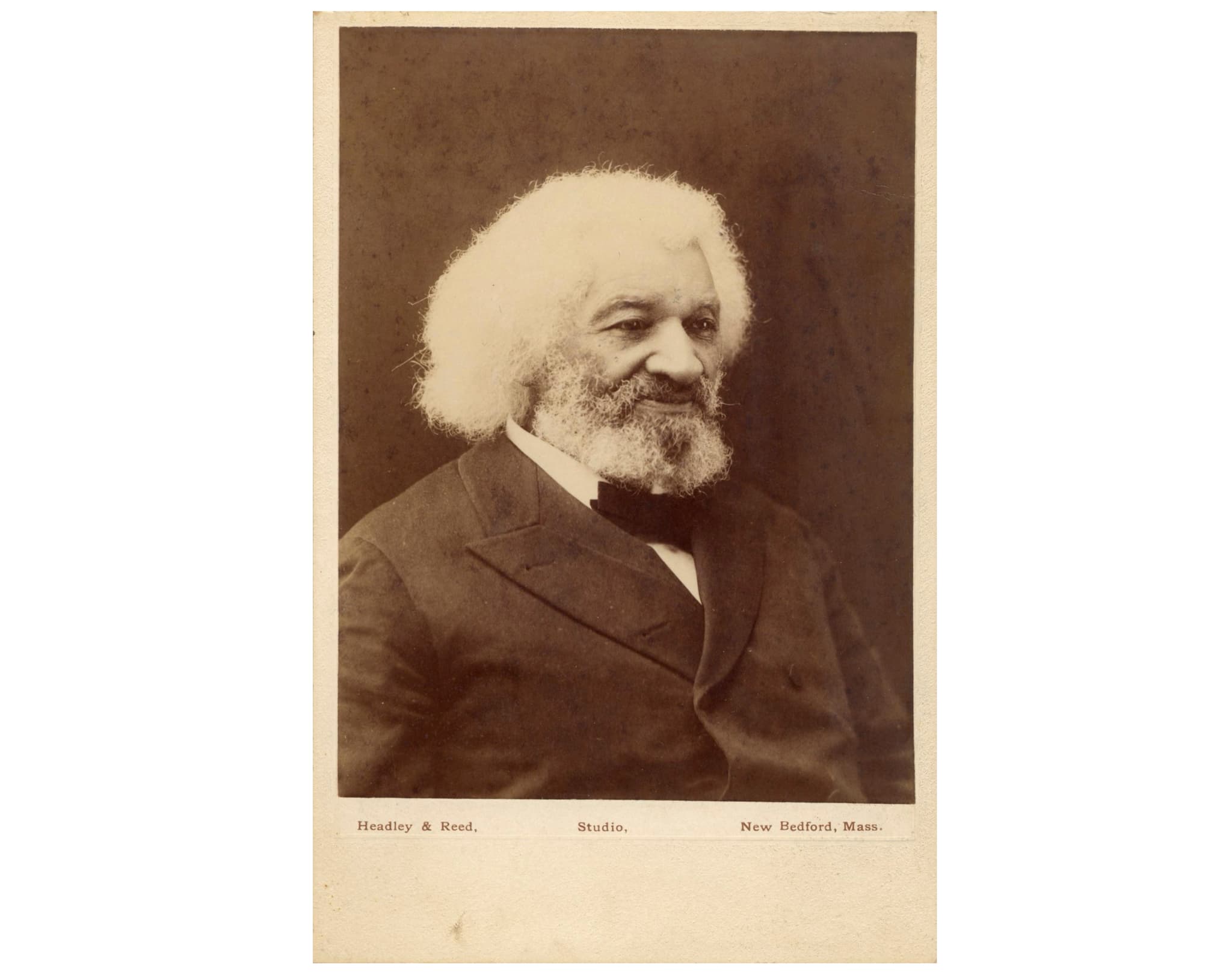
Headley & Reed, Portrait of Frederick Douglass, 1894. Cabinet card, 6 1/2 x 4 1/2 inches. NBWM 1996.21.54. Courtesy of the New Bedford Whaling Museum.
Just before Peale’s portrait of Rotch hang three smaller portraits of the famed abolitionist, photographic theorist, and (at the time in 1894) the most photographed man in America, Frederick Douglass. Douglass’s portrait was shot by James E. Reed, a Black photographer who ran a studio in New Bedford alongside Phineas C. Headley. Instead of the time consuming, stroke-by-stroke construction by Peale, Reed’s photo captures Douglass in an exact instant. Framed by a cloud of white hair, eyes glancing off to the right of the camera, Douglass is shown in the same style as Rotch: a three-quarter profile buttoned up to the collar. But in this case, rather than presenting the portrait as a series of choices made by the artist’s hand, Douglass is captured as he might appear in the real world—that real world bypassing the visual culture of stereotype and caricature imposed on Blackness in the nineteenth century. The photograph both cheapens and clarifies the process of image creation; now Douglass can appear to us as he did in that exact moment, a moment where, just so subtly, he begins to smile.
Because of their increasing availability and accessibility, photographs soon came to be known not just as images but as objects to be bought, gifted, and shared. One example is Portrait of Richard Tobias Greene (ca. 1845/46), which Greene gave to his shipmate Herman Melville after they disembarked the Acushnet as a memento of their time together. Printed on a silver-polished copper plate, the daguerreotype shimmers with detail, capturing the precious realism of sight. These portrait photographs and the materials which comprise them did such a good job of recreating reality, they were often treated as stand-ins for the physical presence of the sitters. Post-mortem photography became common practice, leaving families with an image to mourn after its sitter had gone. Portrait of a Deceased Child (ca. 1850) shows a child shortly after her death, eyes solemnly closed. A splash of rosy blush colors her face, artificially added afterward as a haunting attempt to preserve not her life itself, but what it looked like to the rest of the world.
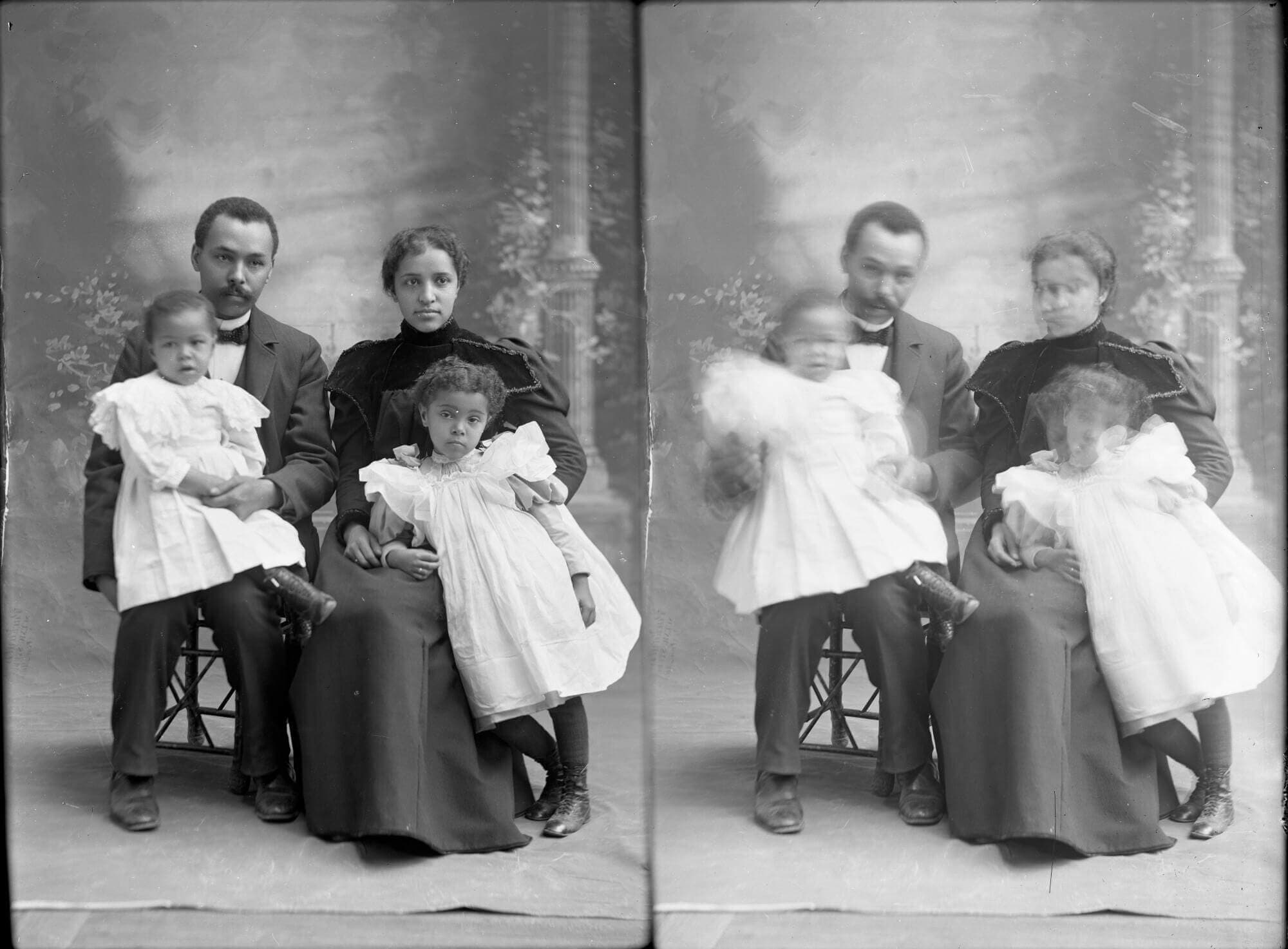
James E. Reed, Reed Family Portrait, 1897. Negative, glass, dry plate, 8 ½ x 6 ½ inches. Estate of James E. Reed. Courtesy of the New Bedford Whaling Museum.
What “Look Pleasant, Please” does so well is explore the lengths New Bedford citizens went through to construct this image of life. And though the act of photography inherently freezes life at a given moment, there are hints at the squirmy, unstoppable duration of life throughout the gallery. One section of the show features a studio chair, a lab coat, and backdrops all used by Reed in his theatrical recreations of life. Among these is Reed Family Portrait (1897), in which Reed and his wife sit with two children perched on their knees. Two negatives are shown as a diptych: The left image is that of a formally posed family, children looking docile and parents looking patient, all with stern, sealed lips and their best Sunday clothes. They certainly look pleasant; you can imagine the tense, silent moment while the photo was taken, life rushing to a halt so that it could be caught in the negative. But on the right, life slips through: Fidgety children schmear across the frame, the parents’ patience blurring into what must’ve been a repeated reprimand. The carefully calibrated images of four figures dissolve into the joyful, rambunctious, tolerant dynamics of a young family just trying to sit nicely for a photo, please! In presenting what might’ve been considered at the time a waste of film, “Look Pleasant, Please” shows not just portraits, but the meticulous work that goes into creating an image of the self. Work which, no matter the century, feels enduringly human.
Soon enough, everyone in the city had their picture taken, and the development of cheaper alternatives meant most people could afford it. For a wealthy port city like New Bedford in the late nineteenth century, the influx of immigrants to support the growing textile industry meant an influx of new subjects to photograph. Carte-de-visite and cabinet cards, which were printed on paper instead of precious metal plates, grew in popularity alongside this growing immigrant community. The Goulart brothers arrived from the island of Faial in the Portuguese Azores, set up a photography studio in New Bedford, and gave immigrants the opportunity to share a glimpse of life across the ocean. Photography couldn’t shrink the distance, but it could provide an alternative. Like stereoscopy—an early attempt at virtual reality—examples of which are on view in the exhibition alongside photos of distant landscapes that together engulf the viewer, it manufactures a glimpse of home.
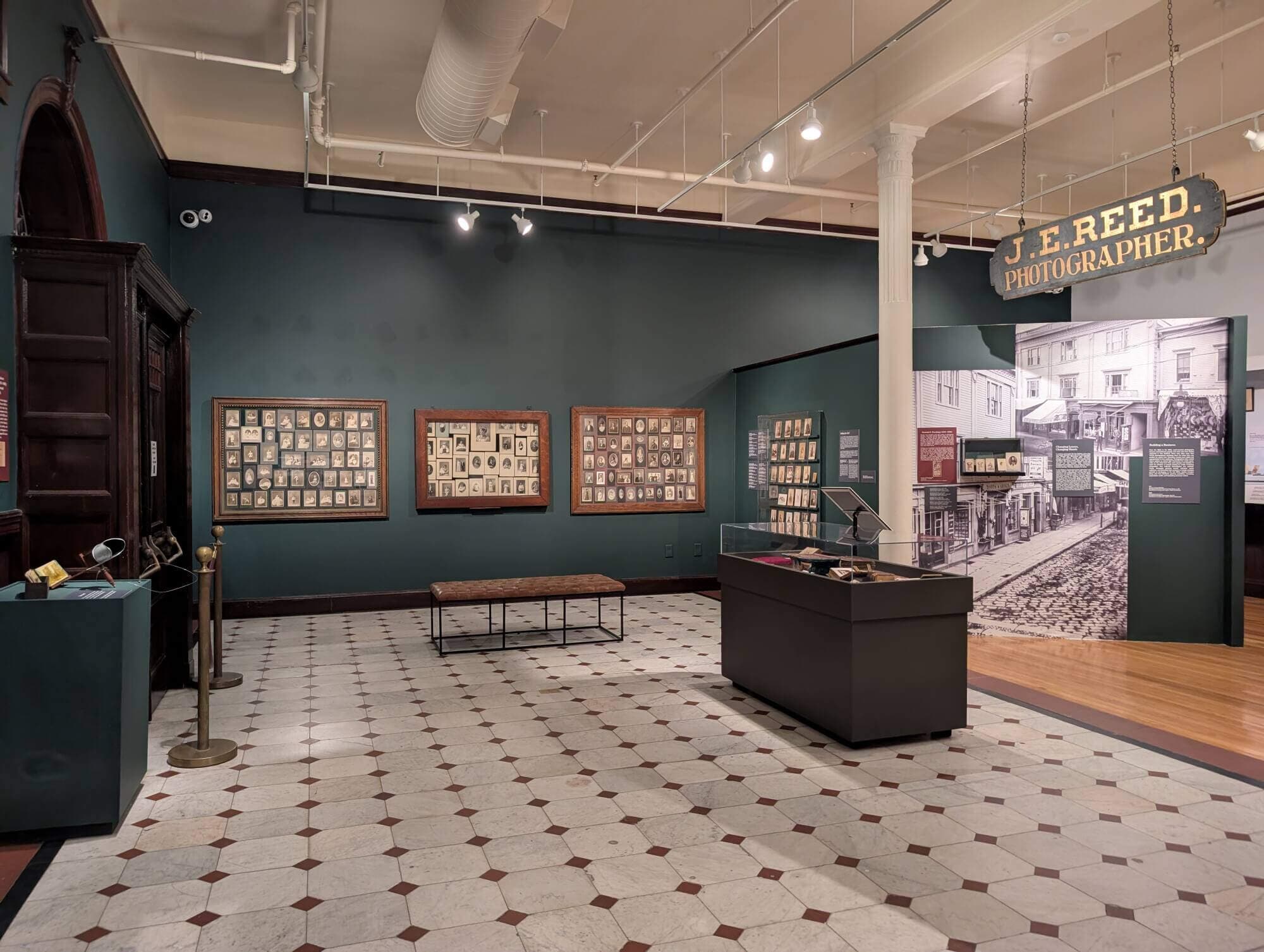
Installation view, “Look Pleasant, Please: Early Portrait Photography in New Bedford,” New Bedford Whaling Museum, 2026. Photo by Michael Lapides. Courtesy of the New Bedford Whaling Museum.
It’s in the cabinet cards by Reed that some of the compelling images of nineteenth-century New Bedford appear. The show features his window displays, which collage various cabinet cards to convince potential clients (and 130 years later, gallery visitors) of his dexterous abilities as a photographer. Prefaced by the squirming, youthful excitement of Reed’s family photos, these window displays teem with life. That life looks like babies smiling, babies crawling, standing, pouting, and laughing; newlyweds posed elbow to elbow; altar boys looking up from a missal; dollops of perfumed hair and curved necks; communion gowns and cheek-to-cheek portraits with grandmothers; hands around a rolled diploma; many obedient dogs and more obedient mustaches; elders bespectacled and bonneted; beards hanging to bellybuttons; and eyes fixed, rigid with the pressure of looking pleasant, into the lens of the camera.
By 1888, Kodak introduced the box camera which allowed anyone to shoot a roll of film and send it off for development. Now, photography moves from the well-calibrated lights and lenses of the studio to the eager hands of amateurs. The final room of the show sends photography off into the world, where the strict formula of portraiture breaks away to the candid, erratic task of capturing life. Photo of a man Running (undated) by New Bedford photographer Henry Dudley Prescott catches the acceleration of life into the twentieth century. A man veers across the composition, pitched forward in a brisk pace, the frame of the photo appearing to slide along with him. And in his hands, a box camera, rushing to photograph whatever waits beyond the frame.
“Look Pleasant, Please: Early Portrait Photography in New Bedford” is on view through September 7, 2026, at the New Bedford Whaling Museum, 18 Johnny Cake Hill, New Bedford, MA